
Keanu Reeves is a good dude.

Hollywood: A place where big careers and humility are mutually exclusive. Where self promotion is the way to what you want. People are used as steps to your goal and having a conscience is something you have to be rid of as soon as possible. Wait…am I talking about Hollywood or Washington DC? Meh, I digress.I say all of these things because it is even more astonishing that there are people who work in Hollywood who manage to not fall into this pit. Keanu Reeves appears to be one of those people. Be mindful of this: This article is not being written to discuss his acting ability. I myself do not find him to be a terrible actor. There have been some roles where he was wooden and definitely roles where he has seemed to be the stoner surfer quite a bit. It is easy to label him as just the handsome guy and that is why he gets roles in movies. But again – not why we’re here. I want to discuss Keanu Reeves the man. So I will.In the early part of his career he was only spoken of for his acting, but as time has passed, he has become known for being humble and generous, and for having a kind personality—qualities that seem to resonate with people on a deep level. People were not aware of what kind of person he is due to in no small way his diligent work at being a private person. In the last 5 years or so, the fact that he is a phenomenal guy has come to the forefront due in large part because of social media.Despite being a huge Hollywood star, Keanu is famously humble. He avoids the spotlight, rarely engages in self-promotion, and has been seen using public transport like any regular person. His low-key attitude, even in the face of enormous success, makes him relatable.I am not sure if this is where it really all started, but this video of Keanu Reeves giving up his seat for a woman carrying a heavy bag might be the first look at who he really is. This seems like such a simple thing, but unfortunately this is really not a normal thing in today’s world. Unlike many celebrities, he doesn’t let fame inflate his ego. There are countless stories of him chatting with fans, taking pictures with them, and treating people with kindness and respect, whether they’re fellow actors or everyday people he meets on the street. There is another story that demonstrates this – he was on a plant bound for California that had to make an emergency landing. Instead of sneaking away to travel on his own, he organized travel for many passengers, riding with them and telling stories.
Respectful with women in a big way. Keanu Reeves has become known for a unique and respectful gesture when taking pictures with women: he often poses with his hands hovering just above or beside them, without making physical contact. This subtle gesture has gained attention and praise on social media, where people have dubbed it the "hover hand" or the "respectful hand." By not physically touching the women in the photos, Keanu demonstrates a respect for their personal space. In a time when conversations about consent and personal boundaries are more prominent, his gesture is seen as considerate and mindful. Just another really cool way that he demonstrates he is the epitome of a gentleman.

Ever give away 31.5million dollars? Keanu has. After The Matrix, he gave that money to support cancer research in honor of his sister who died from leukemia. This was equivalent to 70% of his total earnings from the movie. Prior to that he sold his home to move closer to her so that he could help in caring for her. This resulted in delays for the production of the Matrix sequels, but he knew what was important and people over movies. There are tons of other charities that he has donated to, but that is not where his generosity ends. He cut 90% of his salary for the film The Replacements so that they could afford Gene Hackman’s salary requirements. Does it end there? Not at all. He is a motorcycle aficionado, so he gifted all of the stuntmen for Matrix with brand new Harley Davidson motorcycles. It doesn’t stop there. For the John Wick films, he gave the stuntmen Rolex watches. In the world of cheap, petty Hollywood stars, Keanu simply is not one of them.

Keanu has faced tremendous personal loss—his father left when he was young, his close friend River Phoenix passed away, he lost a child, and his long-time partner also died tragically. He lost his sister to cancer. Despite this, Keanu continues to live with grace, generosity, and positivity. Keanu often speaks about life in a reflective and thoughtful way. He’s known for giving interviews where he talks about the meaning of existence, death, and the importance of kindness, which adds to his aura of being "different" from other stars—more introspective and grounded. There are two instances when being interviewed on the Colbert show we can see this.
And one more video - and this one pretty much says it all.

I’m not crying, you’re crying.

Arthur Morgan. Video game character. Not even real. A figment of someone at Rockstar’s imagination,So, what is the big deal?The big deal is that he is the most complex, nuanced character I have ever ran into in a video game. For that matter, I am not sure that I can easily identify a character that was as round as Arthur Morgan in any full length feature film. He was evil, right down to his bones, but there were aspects of him that could be labeled as coming from the best of men. It is such an emotional game due to its deep narrative, the aforementioned complex characters and the manner in which it explores the themes of loyalty, morality, and the inevitability of change. Arthur Morgan is the epicenter of it all.I have been meaning to write this for a while. I don’t know – is this proof that the character arc of Arthur Morgan has affected me?Perhaps.First of all, lets make it clear – Arthur is a killer and a thief. He is a drunk who gets into fights and does not think twice to let violence solve his problems. There are truly some despicable things that he does. But here is where Rockstar decided to make it interesting – the player decides to a really large degree what kind of man Arthur is. There are some things that are integral parts of the narrative where you have to commit crimes and…gulp…kill people, some who are lawmen trying to bring you to justice. AKA – just doing their jobs, honorable jobs at that. Maybe as people we have become totally numb to the violent ends of people, so much so that it we do not even think about it. I know when I robbed a bank and shot a deputy, I did not think twice about it.Judge me however you like for that.There are many, many other times where you are given a choice in the manner in which you interact with the myriad NPCs that are in the game. Most of the time it is really clear when you have a decision which will have a negative impact on Arthurs aura or a positive impact
RDR2 centers around Arthur Morgan’s character arc, living through the final days of the Old West. His evolution as a character—from ruthless enforcer to a man searching for redemption—is emotionally gripping. Arthur’s internal struggle, particularly as he reflects on his life choices, mistakes, and growing awareness of his own mortality, resonates deeply with players.Arthur’s relationships with key characters like John Marston, Sadie Adler, and Dutch Van der Linde are full of nuanced emotional moments. His bonds with them—whether through camaraderie, love, or betrayal—are deeply fleshed out, adding layers of tragedy or warmth. This is seen in the ways they speak about things and people from their past; these people did life together. The way these relationships evolve over the course of the game tugs at the player’s heartstrings.The Van der Linde gang, the central group in the game, operates on the ideals of loyalty and family. However, as the story unfolds, we see that these bonds are tested, fractured, and often shattered, especially through the slow unraveling of Dutch, the gang’s leader. (He has a plan…) The tension between loyalty to friends and the painful realization that those friends might no longer be trustworthy creates powerful emotional stakes.The setting itself—an era in decline, with the frontier giving way to modernity—adds a melancholic tone. Characters who once thrived in the untamed world of the Wild West must come to terms with the fact that the life they knew is ending. This overarching theme of inevitable change and loss contributes to the emotional weight of the story.The game’s score, composed by Woody Jackson, adds significant emotional depth to pivotal moments. The hauntingly beautiful soundtrack enhances feelings of isolation, grief, and reflection throughout Arthur’s journey. The cinematic quality of the game, with its careful attention to detail in its environments, lighting, and facial animations, makes key emotional moments hit even harder.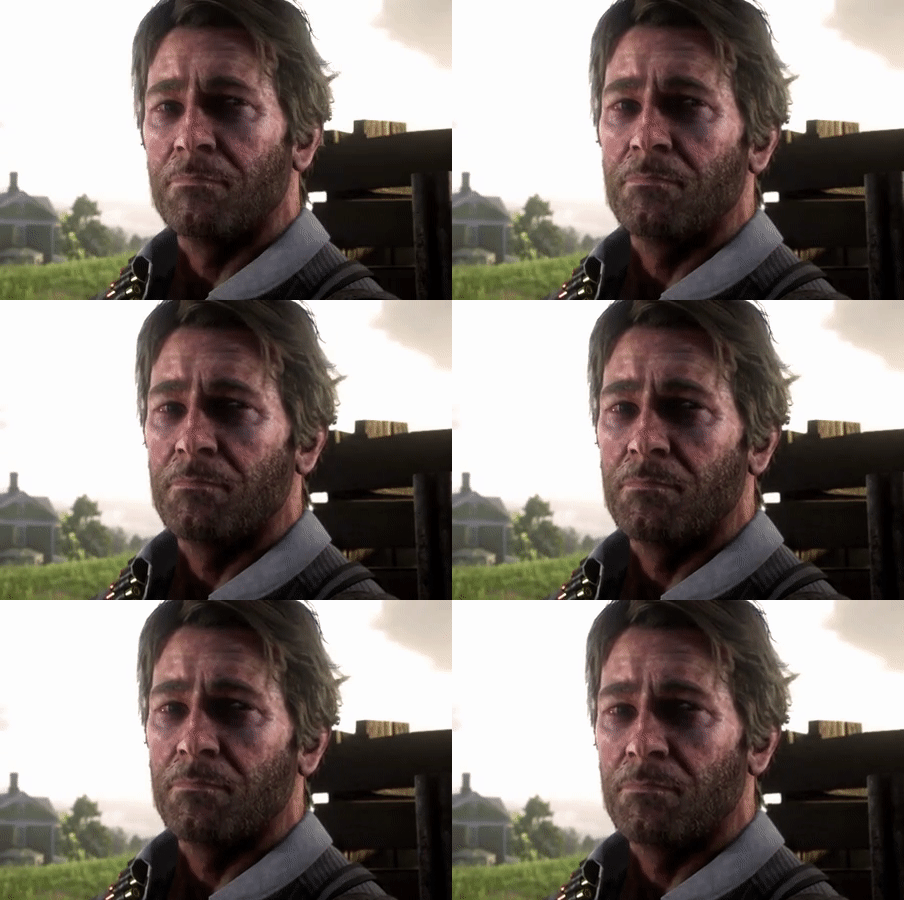
Arthur’s grappling with terminal illness (tuberculosis) adds a layer of poignancy to his character arc. His search for meaning in his final days, his efforts to make amends for his past, and the choices players must make on his behalf (often determining his level of redemption) create an experience filled with bittersweet emotion.This conversation that he has with a nun that come in and out of the story over the course of the game is really hard to hear. Arthur is aware of who he is — and that is truly frightening to him as he knows his end draws near. It seems to me that he is searching for meaning, to discover if his life had any real value. This is something that is eminently relatable to everyone, as we are all searching for that.Arthur’s last ride — I was so emotionally invested in Arthur at this point. It was like I knew him, his good points and his bad points. I had been with him during this journey and I clearly remembered the moments, the audio flashbacks played over a truly sad and reflective song.The combination of music and cinematography was absolutely fantastic.
The multiple endings of the game, depending on the player’s choices, offer different but equally emotional conclusions. Whether Arthur dies with a sense of peace or unresolved guilt, his story remains tragic. Additionally, the epilogue, which ties the game to the original Red Dead Redemption, further intensifies the emotional experience by showing the long-term consequences of the gang’s actions.
It would take me a really long time to list out the ways that I lost myself in this game. From hunting and fishing to taking care of my horse and saying ‘Hey there mister’ to everyone in Saint Denis I simply adored every aspect of this game. It was like participating in a great movie. The only bad things is that it ended. There was a fairly significant epilogue which sets up RD1 that took me a really long time to get the hang of. It was not the game, the mechanics were the same, but without Arthur, it just felt so wrong. He was integral to my love of the game. While there was some sort of closure in the game’s final moments, its just seemed so anti-climactic. I have not played RD1 (Has not been on sale enough yet, dangit) so I am looking forward to seeing where the story goes. It came out before RDR2 so I am wondering about how the quality of the graphics and whatnot will be, but heres to hoping that it will be half as good as RDR2.RIP Arthur
The Matrix has you.

It is 1999 around 1am. You are sitting on your couch watching a movie on your computer that has you totally enthralled. Trouble is the movie crashes with an error message explaining that the file was corrupted. (Ahhh, Napster anyone?) After several attempts to play the file again, you give up dejectedly and try to figure out what to do.
What to do is get your clothes on and doggedly head out to the local Walmart. It is a dodgy proposition considering what you might see at Wally during the day – as this is middle of nowhere rural Illinois, you know this is probably a bad idea. Onward.
You come home with a VHS tape that you hurriedly pull the plastic wrap off of and jam into the VCR. Fast forward to where you were and sit back down. At least now you are watching it on the TV with a bigger screen.
This was how I became acquainted with The Matrix. What a movie! It had everything that I already knew made for a good action film and so many other things that I had never seen before. It was just…cool.

The Matrix was easily one of the biggest hits of the 1990s and arguably one of the most influential action films of all time. It spawned 3 sequels and made close to 2 billion dollars. The Matrix” became a cultural phenomenon. Phrases like “taking the red pill” entered mainstream language, symbolizing waking up to uncomfortable truths. It inspired everything from fashion trends to philosophical debates, influencing pop culture, technology, and science fiction for years to come.
I teach Film as Literature and we are presently going through the sci-fi unit. The Matrix was not on the list of movies to watch (there are some great ones on that list however – Interstellar, Arrival, 2001: A Space Odyssey, and Blade Runner, the 1982 version) so I let them start watching it while working on some other material. I just think they had to be introduced to it.
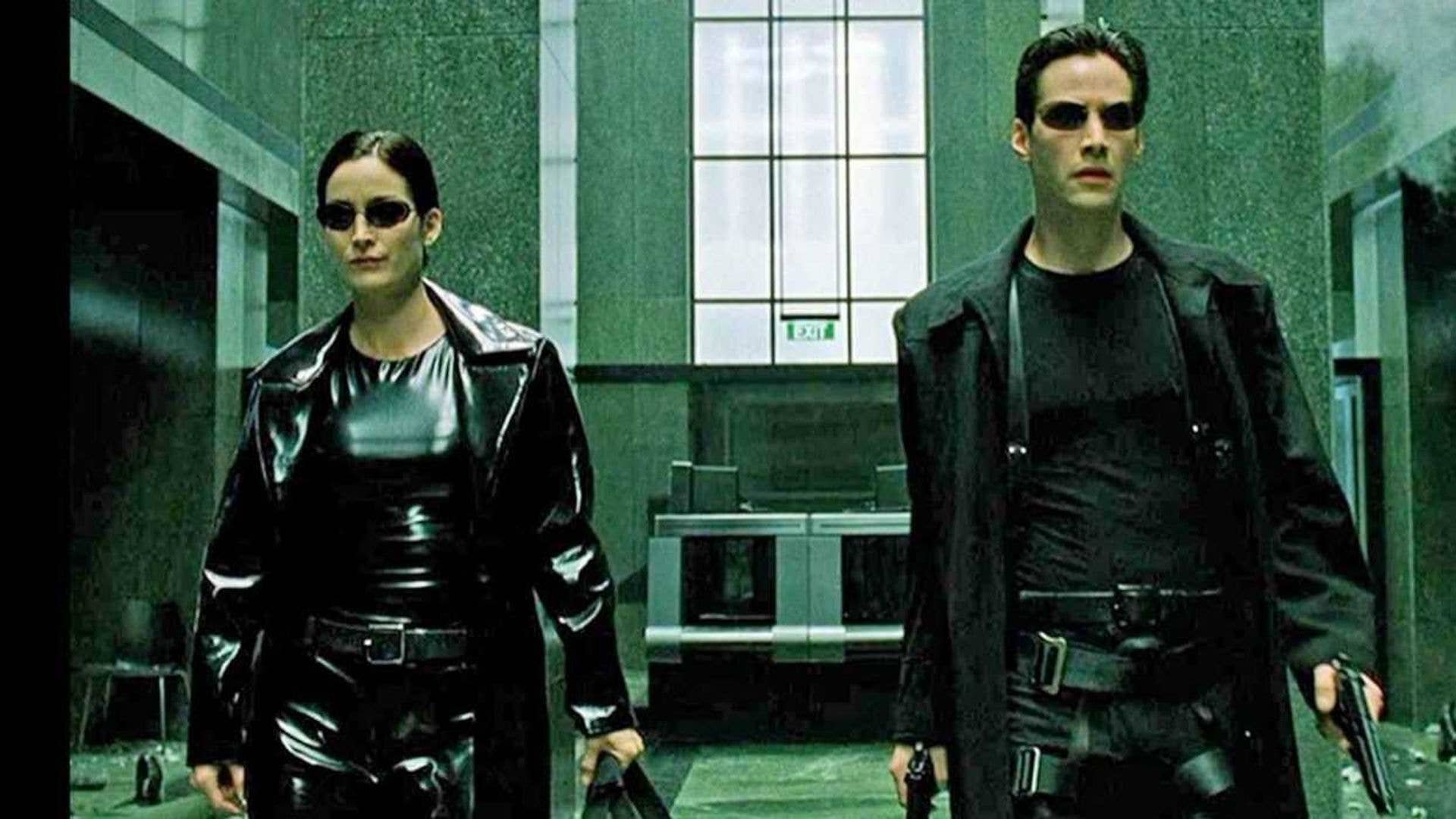
First of all, the visual effects and cinematography were groundbreaking. The film introduced “bullet time” effects, where time slows down while the camera moves at normal speed. This innovation became iconic, influencing many action films and video games. The Matrix’s choreographed fight scenes, particularly influenced by martial arts, are fluid and thrilling. The use of wire-fu techniques, along with stylized slow-motion and gravity-defying stunts, set a new standard for action cinema. The blending of bleeding edge technology and classic cinematic techniques was incredible. I particularly like the use of long, long takes. It made you feel like you were there, totally immersed into the cyberpunk aesthetic.
All of that would be meaningless if it were not for some pretty cool storytelling. The story idea was not new, but the concept of reality versus simulation was easy to buy into. The question “Is this real?” is asked in many films, perception versus reality being a common theme, but free will and reality became really intertwined, and the allegory about waking up being thought provoking. The movie taps into timeless concerns like control, freedom, rebellion, identity, and reality, which keep it relevant even decades after its release. Audiences continue to see The Matrix as a reflection of modern-day technology and surveillance, adding layers of meaning with each new viewing.
The Matrix also introduces viewers to a rich, complex universe filled with lore, such as the machine-controlled dystopia, the real world versus the simulated world, and the existence of Zion (the last human city). This detailed world-building lends a sense of depth and invites audience immersion.
The story of the Matrix is easily connected to Plato's work.
Character development was on point as well. Morpheus, Trinity, Agent Smith: Each character is distinct, with clear motivations and personalities. Morpheus is the wise mentor, Trinity the strong and loyal fighter, and Agent Smith the relentless villain embodying the system’s oppressive force. Their acting was, while at times wooden, pretty good overall for an action movie.
The movie had an impact on society as well. Along with the aforementioned red/blue pill references, the amount of cool factor it had on society was immense. Black leather, trench coats, sunglasses – combining this with crazy martial arts abilities and hacking skills – made them instantly iconic and in no small way contributed to the film’s lasting cultural appeal. When 90’s goth was beginning to die out, The Matrix brought it back again for its swan song.
This video says it all – even after 25 years, The Matrix stands the test of time. It can be watched today, or for the umpteenth time, it does not disappoint.

What to do, what to do…

What to do. Want to be creative – blocked. What direction to take…is it to be things you are passionate about, or things you are good at already? Both? I have this platform and it is not being used for its specified purpose, so then why do I have it?I am a hypocrite. There is a student who I tell to, “make art!” — I do not follow my own advice. This changes now.So what does this mean? It means that I am probably going to be producing some hot garbage. It might have things that are going on in my life, pics/videos of my kids, and other projects that I am taking part in. I do not know how or where this is going to go, but it is going to go.Go make art.