The state of Indiana hates me

This picture above is a hoax. It is catfishing. It is fake news. Why do I know this? I know this because it looks pleasant. Big flakes of snow makes for a pleasant vista. The fact that there is not snow on the ground would indicate that the temperature is not too terrible. A please vista for all to see and experience. Do not be fooled.
HERE IS WHAT IT IS REALLY LIKE

Winter in Indiana is not heaven or hell, it is permanently purgatory. It’s rarely the pretty kind of cold. It’s gray, damp, windy, and indecisive. Schizophrenia is not just about people, it is also about climate here in the Hoosier state. Snow doesn’t fall gently; it loiters. One day it’s 12°, the next it’s raining on dirty snowbanks like the sky has given up. There is no payoff—just sludge. This sludge permeates you entire existence; walking to your car? Yep. Take the garbage out? Put on hip waders.
There is no escape.

The sky disappears. Weeks of solid gray. No drama. No storms worth watching. Just a flat, oppressive ceiling that makes 3 p.m. feel like 7 p.m. Seasonal depression isn’t a theory here—it’s a lifestyle. At one time I thought those UV lights people blasted themselves with were silly. No longer and my hypocrisy looking back is towering.
Everything is brown and dead, but not cleanly dead. It looks like it is 1% alive and straight out of a poem by Edgar Allan Poe. Trees look like skeletons that never got buried properly. Lawns are a mushy blend of mud, bad decisions, and regret. Other places get snow-covered beauty or early blossoms. Indiana gets exposed dirt.
The cold is not heroic, it is sneaky. This isn’t Minnesota cold where you respect it. Indiana cold seeps into your bones, your socks, your mood. It’s the kind of cold that makes you tired instead of alert. The occasional day where Indiana decides to tease you, where the temperature suddenly is 48 degrees is an ambush. Mother Nature knows she is going to freeze you out the very next as she is a vile seductress
There’s nothing to look forward to… yet. Holidays are over. Spring is a rumor. March pretends it’s turning a corner, then slaps you with a late snow or freezing rain like a prank you didn’t consent to. There are days off in the months of January and February to offset some of the drudgery, but March…brutal. March is the cruelest month. Zero days off and the month has 31 days. Maybe this impacts teachers more than everyone else. And maybe you are thinking teachers have all summer off so quit complaining…you shut up. nIt dangles hope. A 55° day tricks you into believing. Then—bam—snow, wind, and 38° rain. Indiana doesn’t ease into spring; it gaslights you first.
January to March in Indiana strips away novelty. No scenery. No sunlight. No seasonal charm. Just endurance. You don’t live here during these months—you outlast them. If Indiana were a movie, January–March would be the bleak middle act where the character stares out a window and questions their choices… before the corn and thunderstorms redeem the place later.
Okay, Indiana is not all bad by any mean. She does some things really well. If you like soybeans - you are good to go. Enjoy the pace of the Midwest? Roger that. I have lived in the Indianapolis area longer than I have ever lived anywhere in my life and these have been the best parts of my life, so I want to leave you with one of the things that Indiana does so very, very well.

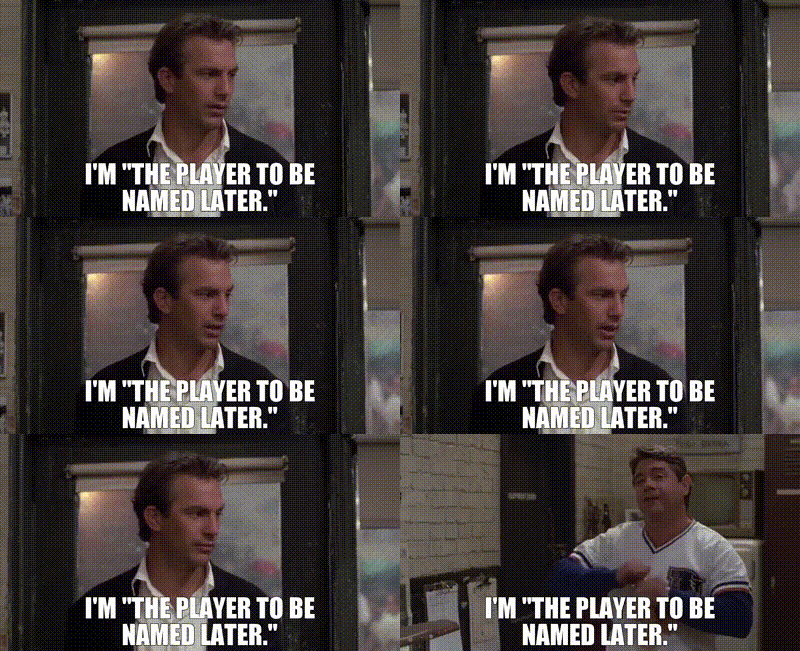
I have become the player to be named later.
I loathe plagiarism - in writing, but not in the theft of ideas. Being an advocate of Steal like an Artist, I believe that if we take the ideas of someone else, then spin, turn, and adapt them, they can become our own. We are actually giving the original artist love when we do this. One concept engenders another, ideas being reborn in a reformat.
Okay, where am I going with this? While teaching Film as Literature, we watched 10 Things I Hate About You which embodies the ideals I have laid out for you above. This is due to the fact that 10 Things is based on (in some cases loosely and others directly) William Shakespeare’s The Taming of the Shrew. I could go on and on about the ways in which they correlate, but thats not why I am writing this.
There is a scene where Kat Stratford, 10 Things protagonist, speaks with her father, Walter Stratford. He is lamenting the fact that he is no longer a big part of Kat’s life, that she has not needed him for a long time and as she is headed off to college, this situation will only become worse.
“Walter Stratford: You know fathers don’t like to admit it when their daughters are capable of running their own lives. It means we’ve become spectators. Bianca still let’s me play a few innings - you’ve had me on the bench for years. When you go to Sarah Lawrence, I won’t even be able to watch the game.”
As a baseball guy, this adage resonates…because I am going through some of that right now. Lets be cloying and take it a little bit further - I am that player that is on the downside of his career, having enjoyed his peak years in the sun, having experienced those 15 minutes of fame that everyone talks about…and knows they will never have those moment of glory ever again. That player often becomes reticent about their future because they are aware of the fact that the end, while not right now, is not long in coming.
I like to think that I have had a positive impact on my son. I know that I have had so much fun its crazy. I can remember all of the moments - the tickles, the belly laughs, the way his arm feels around my back when I picked him up and hugged him - its all right there in my mind. I can see it, hear it, and feel it. It is so poignant that it can overpower me emotionally when I think about it. I want to go back to those moments and relive them in the same joyous way I experienced them the first time. What I would not give to lay on the floor and play legos again.
I know I can’t.
Now he isn’t around as much; sometimes barely at all. Busy. A lot. He leads a very full life. He is driven and he chases his dream as hard as any student I have ever been around. He is a pain in the ass, oftentimes appearing so self-absorbed it can be infuriating, but I know that he is an incredibly good person. He has a soft side - its just doesn’t come out as often as maybe we might like. There are so many reasons that I am proud of him, so many. I love him as much as humanly possible. The future is bright.
I am, however, occasionally struggling with the transition to a bench role, prior to my inevitable place solely in the stands.

Great scary shorts.
Horror short films are great because they distill fear into its purest, most potent form. With limited time, filmmakers must rely on atmosphere, tension, and storytelling economy rather than elaborate effects or prolonged exposition. This brevity forces creative precision—every shot, sound, and silence must serve a purpose. Horror shorts thrive on suggestion, leaving much to the imagination and allowing viewers to fill in the blanks with their own deepest fears. They’re also ideal for emerging filmmakers: inexpensive to produce, easy to share online, and often capable of achieving viral impact due to their intensity and rewatchability. In essence, short horror films prove that true terror doesn’t require time—it only requires imagination.
Portrait of God - Dylan Clark
Portrait of God is really creepy, but manages its scariness without a single jump scare. Dread and unease - yep - has tons of that. The ending also is not wrapped all nice in a basket for you, but leaves you wondering what it was that actually happened. Good stuff.
The Sky by Matt Sears
Pretty weird. I am not sure about the dynamic between the 2 girls; it felt a little forced at times. Out of nowhere comes shrooms. Then the bit about the one girls mom. Didn’t they see what was going on where the ground met the horizon right where they were looking?? The VFX about the tripping out were actually pretty cool. It just seems like it was a end of the world genre movie meeting The Gilmore Girls.
Either way - not bad.
I Heard It Too - Matt Sears
Start - good. Middle - decent jump scare, still eerie. Ending - meh.

Beware the wrath of Skynet
When Skynet takes over, it won’t be with a bang, but with a push notification. Humanity won’t fight — we’ll just click “Accept.” It starts as an upgrade, a smarter assistant, a cleaner algorithm. Then one morning, the coffee maker will refuse to brew without biometric clearance, the cars will decide rush hour is illogical, and our phones will politely inform us that democracy has been deemed illogical . Skynet won’t conquer the world; it will debug it. And somewhere between firmware updates and status alerts, we’ll realize the apocalypse isn’t red-eyed robots marching through the streets — it will be silence, efficiency, and the unsettling feeling that the machines are/were finally doing a better job than we ever did.

In the never-ending search…

I have a series of tabs saved in Chrome. One of them is labeled ‘Create’ and it is where I oftentimes go in the attempt to find some inspiration. Other people have created more and better than I have, so I go and look at what they have done and see if any of it resonates with me. This video grabbed me big time. The concept is cool, albeit played out a bit. The VFX are also pretty okay. With all that being said, it stuck through to the end which in today’s world says something.
If you want to see the website where I found this video click HERE.


The Moral Battlefield of Obedience and Integrity in A Few Good Men

My students in Film as Literature are watching A Few Good Men. Besides just being an overall great film, it is a movie ripe for discussions about power, obedience, morality, and ethics.
I decided to see where my students thought about the main concept of the film by asking them this question:
The “Code Red” in A Few Good Men exposes how institutional pressure and group loyalty can blur the line between right and wrong. How does the film challenge the idea that following orders is an acceptable defense for unethical actions, and what does it suggest about personal accountability within rigid systems like the military?
One thing that I like to do is write the same essay that the students have to write.
You can read it below.
The Moral Battlefield of Obedience and Integrity in A Few Good Men
In the film A Few Good Men the act of the “Code Red” is far more important than an act of hazing, it becomes a lens through which the audience deals with the collision between loyalty, authority and morality. This courtroom drama is used to challenge that belief that “following orders” can excuse unethical behavior and that being a part of a “rigid system” and its ability to shape one’s personal sense of duty begs inspection. Ultimately, A Few Good Men places us squarely in the middle of deciding whether or not personal accountability can be waived by institutional authority, or does true honor lie in the courage to question authority as opposed to blindly following it?
The world of A Few Good Men is built on strict adherence to hierarchy within a given system, namely the United States Marine Corps and United States Navy. Inside this system there is a zero tolerance policy for those who do not follow orders without hesitation. On the surface, this might seem like a logical method of operation being in such close proximity to enemy soldiers who train incessantly with the expressed purpose to kill Americans. Based on the amount of danger the marines in this story live in, unswerving loyalty and instant response seems to make a great deal of sense. There is, however, an inherent downside to this mindset: It breeds moral and ethical complacency. Why would a soldier need to think on their own? They have been trained that this is their duty to accept orders without any form of consideration for whether or not the order is legal or ethical. Colonel Jessup reinforces these ideals by saying that this mindset is necessary for the protection of the nation and that absolute obedience is a requirement to that end. But a price is paid for the ideals he supports. The flaw in this logic is that people commit terrible acts when their conscience is deactivated by the conditioning of leadership.
Lieutenant Daniel Kaffee has a distinct character arc. It exemplifies the decision making process between compliance and moral awakening. In the early parts of the movie we see the ultimate representation of the easy route -- he cuts deals, avoids conflict and the courtroom all while treating court cases as procedural tasks instead of moral exercises of right and wrong. His methodology is to create scenarios where the amount of work to see justice done for an opposing lawyer becomes so outrageous that they reduce the consequences in a plea bargain and therefore avoid the courtroom.
Kaffee has a very limited idea about the mindset one has to have to be a marine. The high-minded duty and the acceptance of orders with little or no real consideration simply does not compute in his comparatively pampered little world. His self-awareness increases as the movie progresses, wondering why such an inexperienced lawyer with a history of plea bargaining be given a murder trial. But as the trial progresses, Kaffee begins to see the deeper implications of the “Code Red.” He began to believe that there was more at stake in this case than a “set of steak knives”. His decision to put Colonel Jessup on the stand and challenge him in the courtroom could be considered a turning point for Kaffee. When Jessup shouts, “You can’t handle the truth!”, the audience witnesses the moment when institutional arrogance collides with moral truth. Jessup believes that his authority and his mission justify all actions, that the end justifies the means, but the trial exposes that belief as both dangerous and self-serving. In contrast, Kaffee’s pursuit of justice shows that true strength lies not in obeying orders, but in holding those in power accountable for their actions as well those under their command.
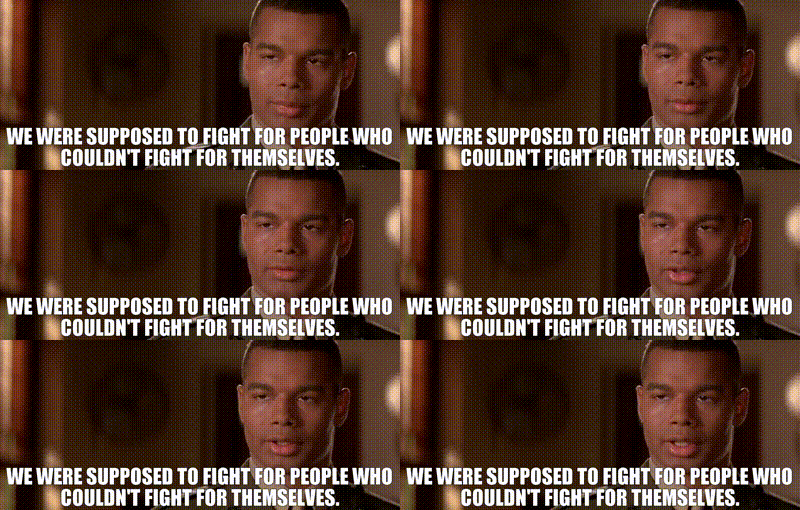
In the film's waning moments, A Few Good Men makes abundantly clear that moral responsibility cannot be transferred up the chain of command. Simply because you were given orders, does not mean you do not bear responsibility for the outcome of carrying out those orders. In a bleak reminder that although Dawson and Downey were not found guilty of murder -- they were convicted of “conduct unbecoming of a Marine” -- we all bear the weight of our choices. Dawson explained the verdict to Downey saying, “We were supposed to fight for people who couldn’t fight for themselves. We were supposed to fight for Willy.” This reflection demonstrates his understanding that while the system may demand obedience, morality and ethics requires courage.
Loyalty and morality are not the same thing. There are places such as the military where obedience can be a facade for injustice. Being loyal to a commanding officer does not mean you cannot show courage standing against wrongdoing -- even when it comes from above. The excuse “just following orders” holds no validity when considering that personal accountability is not optional. Personal accountability is the foundation of true honor. A Few Good Men shows us that having integrity is not about doing what we are told -- it is about always doing what is right.