20 Ways to Slow Down

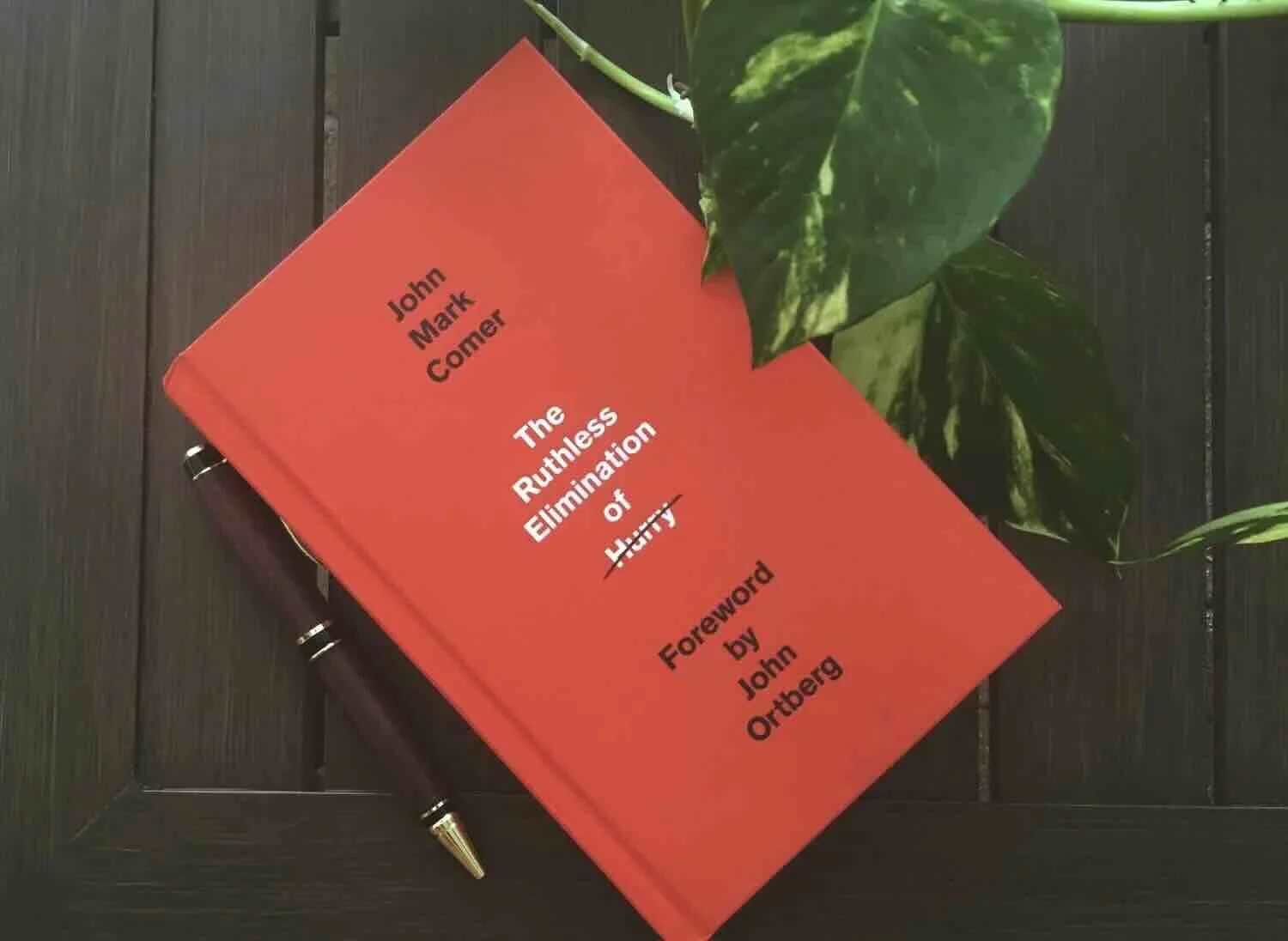
I just finished The Ruthless Elimination of Hurry, and it was an impactful read. I know this because it irritated me as I read, irritated because it called me out on all my crap. No one likes that, but after I was able to get over myself, the truth of what he was saying became clear to me. So much so that some of the things he was saying we should be doing, I found that I had begun doing them without conscious thought.
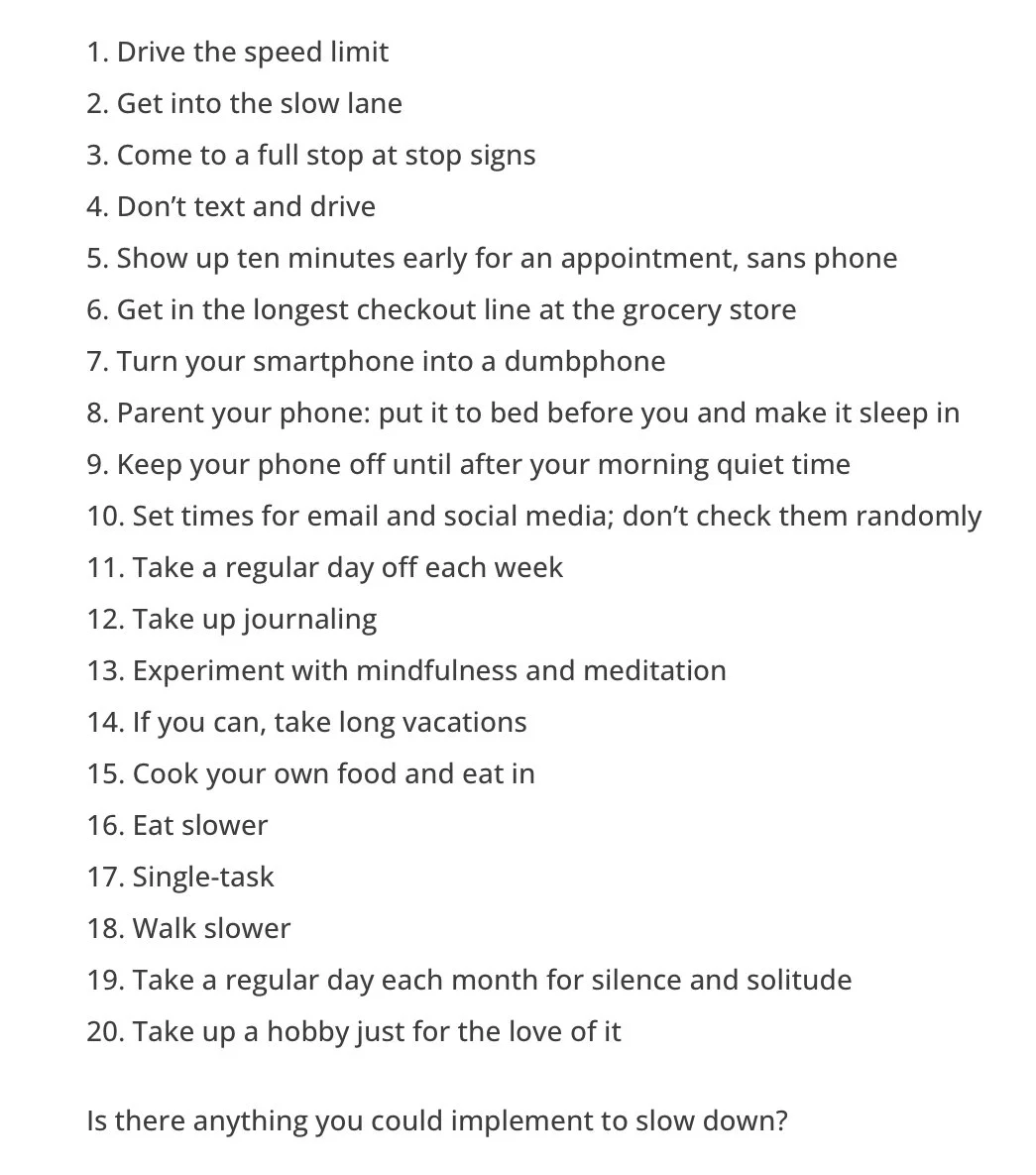
As Comer lists these 20 practices, he speaks with grace and allowance. This is his list - it does not have to be my list. While some of them are existential - if texting while driving is a common practice for you, perhaps you should question your life. Comer tells us to change the list any way that we like; make it our own. Just do something.
So that is where I am, trying to figure out what I am going to do, ergo, I am going to go through the list here and parse out what I am going to do about eliminating my hurry.
Drive the speed limit
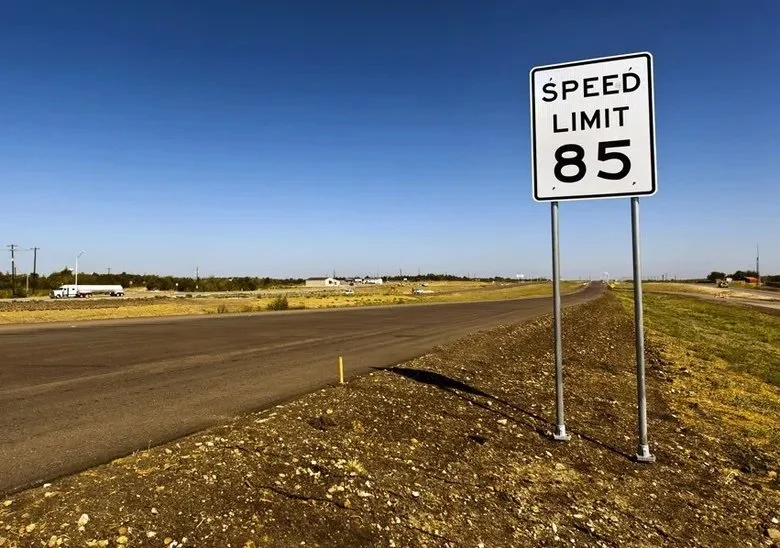
This one is hard, but I am going to give it a shot. First, this means that I am going to need to get my crap together and not be late leaving anywhere. Second, it is just a habit, and those are hard to break. But there are some positives. I have come to like my drive to work and home (1.5 hours) because it allows me time to listen to all kinds of media. Listen to the bible app? Check. Baseball podcasts? Absolutely. Great stories? Those podcasts are everywhere.
2. Get into the slow lane
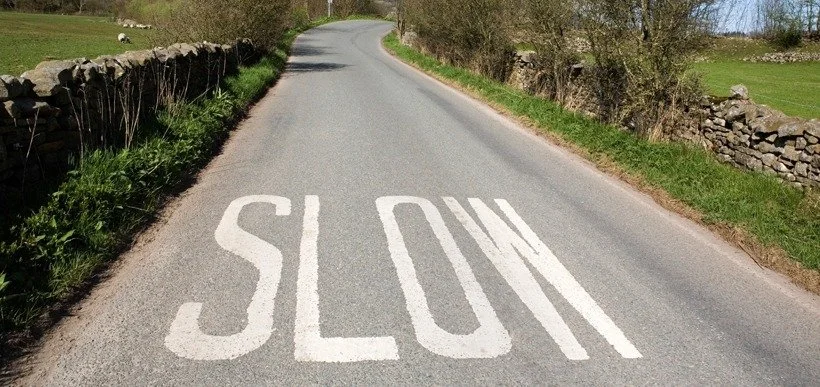
This one is easily harder than #1. This is the lane where people who do not even do the speed limit hang out.
Painful.
Upsides? Maybe I can save money on gas and listen to even more podcasts.
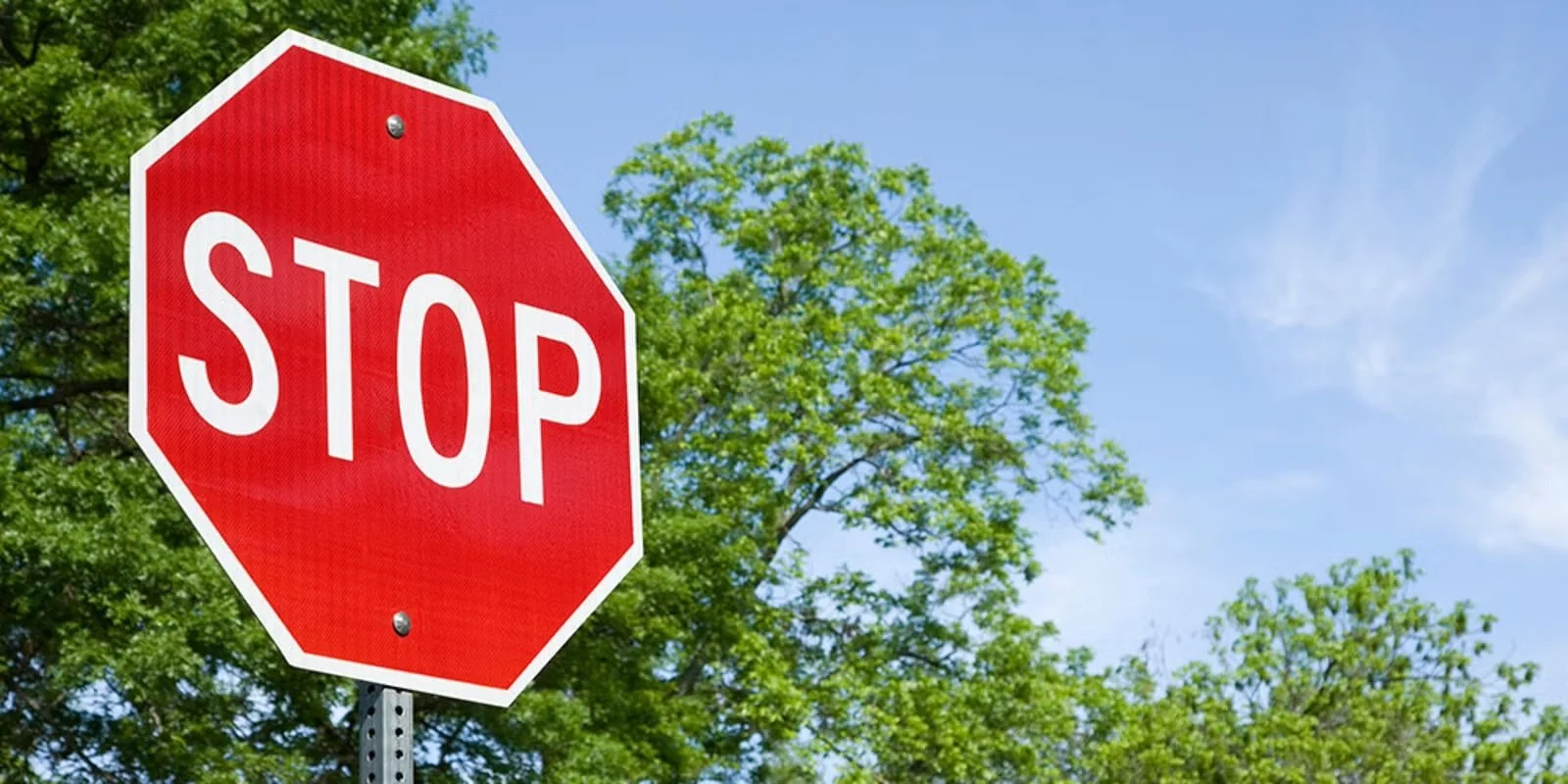
3. Come to a full stop at stop signs
This one goes hand in hand with #4 - this one could save lives.
Also, having pulled out in front of someone in the past still causes me some stress when I cross a country road, so going slower will give me the time to process.
Oh yeah, obey the law too.

4. Texting and Driving
I could sit here and tell you all of the bad things that can happen to you and other people, but you know that.
The whole idea of being present and being present while hurtling down the road at 70 mph seems like a pretty good idea.
5. Show up 10 minutes early for an appointment without your phone
This one I do already after a sort. For example, my lovely bride always tells me that she will check me/us in when we go to get haircuts. I tell her that I will just show up and go from there.
Now the part about the phone is harder. I have sat there with my phone getting to the end of the internet while I wait. I should be reading, or praying, or just examining the world around me.

6. Get in the longest line at the grocery store
Impossible. Nigh impossible. Why would anyone want to do this? After fighting through aisle after aisle, dropping money as if I have lots of it, you want me to spend even more time there? I become totally frenetic at this point. If I am with the boys, it is when I become the most curmudgeonly. I do not want to interact with the checkout worker while I toss endless items onto a moving belt designed to efficiently take me to financial and emotional ruin. I WANT TO LEAVE!
Yes, it has occurred to me that this is the very reason I should do it. Learn to deal with who I am in this moment.
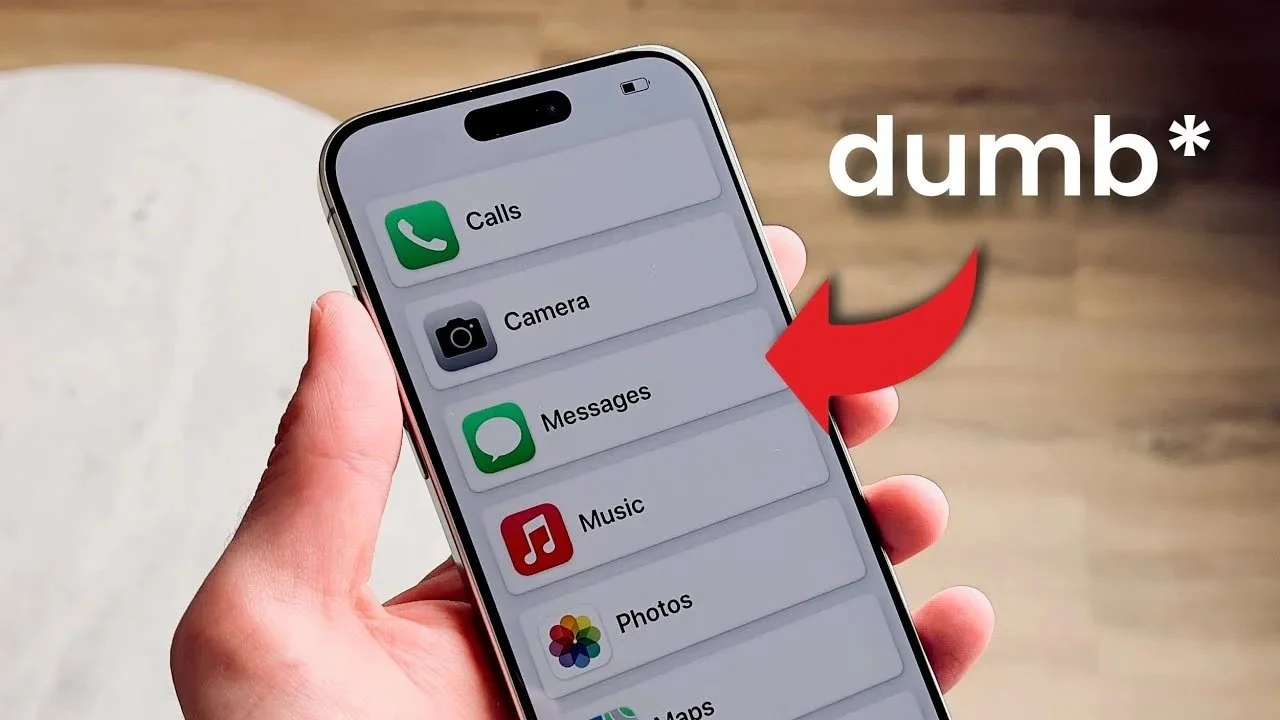
7. Turn your smartphone into a dumb phone.
JMC tells us to take away some of the things that make the things so dang alluring.
Remove:
Email
Social Media
Anything that does not truly make life easier/better
Social Media and Email are to be done on the computer at set times of day for set periods of time.
He speaks of changing the color to a gray scale; pretty much makes it gross looking.
This actually makes sense to me because it is the object that is more likely to stop me from being present in any given moment.
There are some apps he keeps and uses on the phone - Instagram and Twitter, but Comer believes that Facebook is the worst, a terrible place where conservative Christianity goes to play, and it should never be used.

8. Parent your phone; put it to bed early and have it sleep in
I talked to a ton of people at work, and this one is tough. When I brought up the idea of leaving your phone in another room, it did not go over well. There were lots of reasons. From it’s my alarm to that’s what I do before sleep - there was lots of pushback.
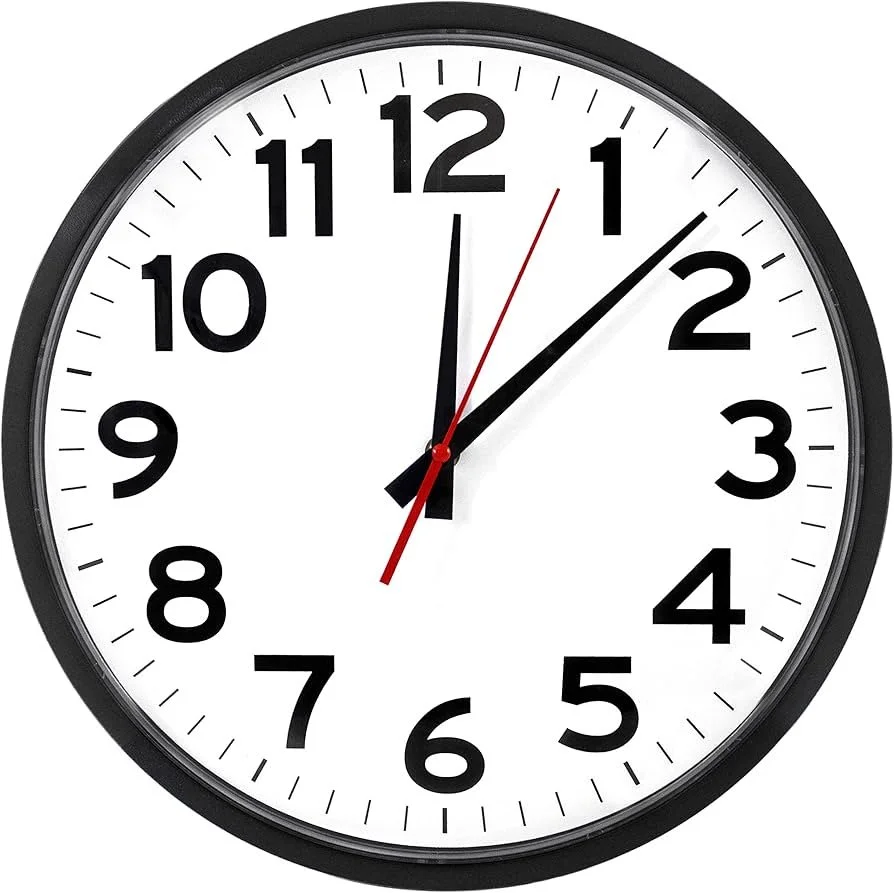
I am going to try this one - to the right you can see the alarm clock I am considering getting.

9. Keep your phone off until after your morning quiet time
This one is both easy and hard. If you have a routine that you follow in the morning, not as hard to leave the phone alone. If you don’t really have a consistent routine, it is probably going to be a more difficult task not to check feeds right off the bat.
Its a good time to read your bible, or just read while enjoying a cup of coffee.
10. Set times for email and social media; do not check them randomly
This one. This one is pretty sucky. I say this because I find myself caught by this one a lot. Ashamedly. Walking down the hall for 10 seconds - what’s on Insta? After reading, I am now at least noticing it. But it’s worse; when I do catch myself and leave my phone in my pocket, it is uncomfortable. So I am so addicted to the dopamine hit that it feels bad when, during a 100’ walk down the hall I can’t take my phone out?? Pitiful.
Now, when I am walking here to there, when I think of it, I put the dang phone back in my pocket and just be present.
11. Take a regular day off each week
This is another one that is really, really tough. I know what we are told to do, but I am losing on this one to the world. There are so many things we do on the weekends that I often look forward to Monday because that is when I can slow down. When I start to feel worn out by this, I try to remember that my children are not going to be here forever and that someday I will look up to a really quiet house. I do not want to regret any of my time now and how I spend it.
12. Take up journaling
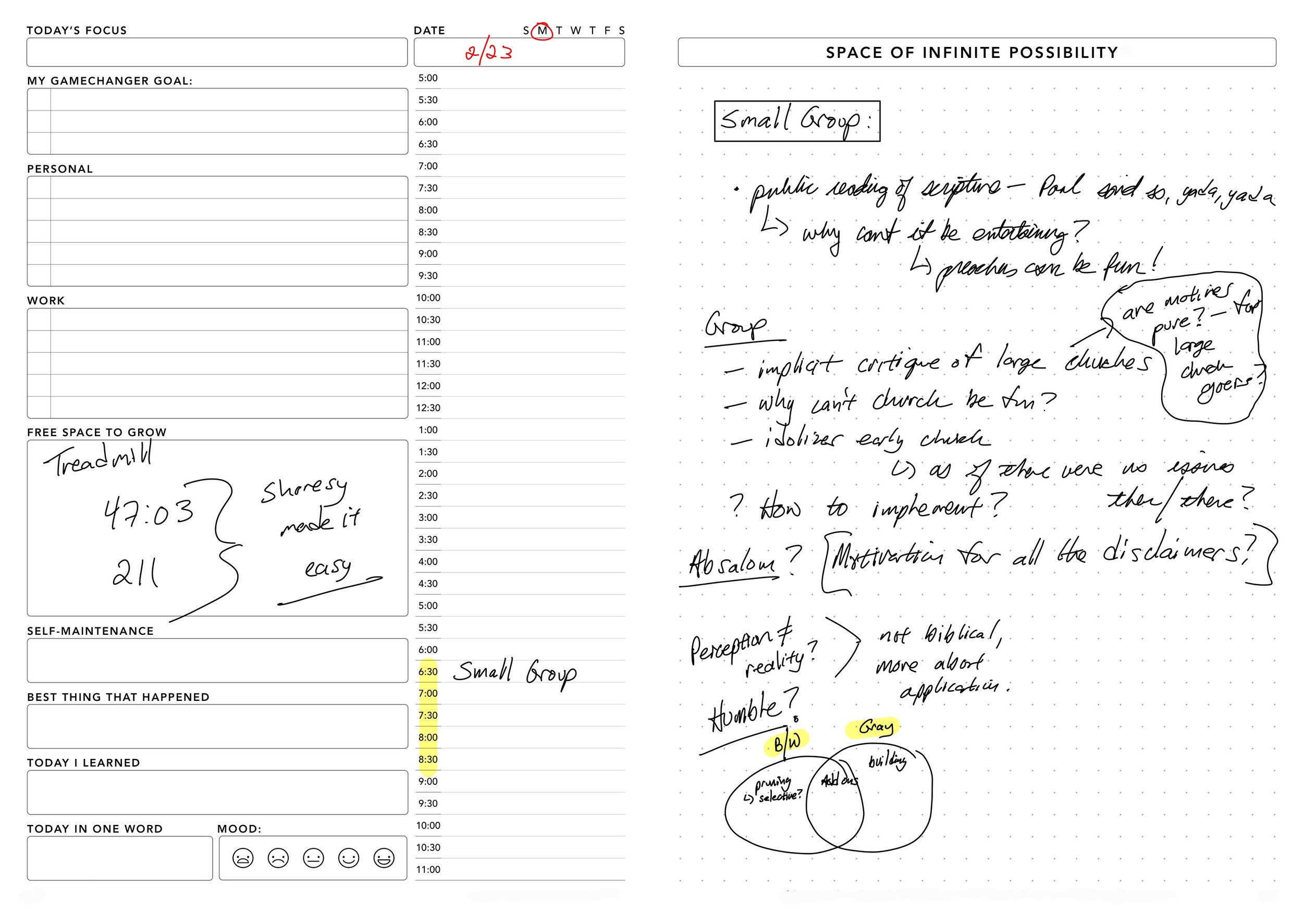
This one I already got beat. I have journaled extensively over the last 3 years. I use my iPad and a handwriting app to detail my little existence. I really like it because I can add pictures, which really makes it look cool and helps me remember all of the moments that go by so darn fast.

13. Experiment with mindfulness and meditation
To be honest, I am not always sure what being mindful is. Is it being aware of certain behaviors? Is it being aware and then changing behaviors that are damaging? Work in progress there.
Meditation - I have started messing with this again. I say messing because I have done it before…and promptly fall asleep. But from this book, I have a new tactic. I think of Jesus the entire time. The gifts, the forgiveness, just…Him. Doing this, I am trying to hear Him speak to me. In the quiet.
Still not good at it, but as with all things, it is a work in progress.

14. If you can, take long vacations
According to JMC, your relaxation peaks at day 8 of a vacation…I cannot even come close to remembering what that is. I mean, I have summers off, but they are busy as all get out now. I know I have never taken a vacation that long with Libby, for the usual reasons: money, time, blah-blah. This is something I will probably be able to do someday, but not today.

15. Cook your own food and eat in
This is one I am willing to do a lot more of. I feel like we can do a nice meal for $50, and that is about half of what it costs us to go out. I understand that you have to cook it and then clean it up. Totally get it. But I like to do it. Maybe I need to just tell Libby that I will both cook and clean. I know she hates that - not that I blame her, just think it would make sense both nutritionally and financially

16. Eat more slowly
This one seems like a no-brainer. You feel full before you have thirds on the mashed potatoes, and you get to enjoy the company of your family for a longer period of time.
I am one of the worst at this, and I need to work on it. When dinner is done, I am out of there and on to what’s next.
17. Single Task
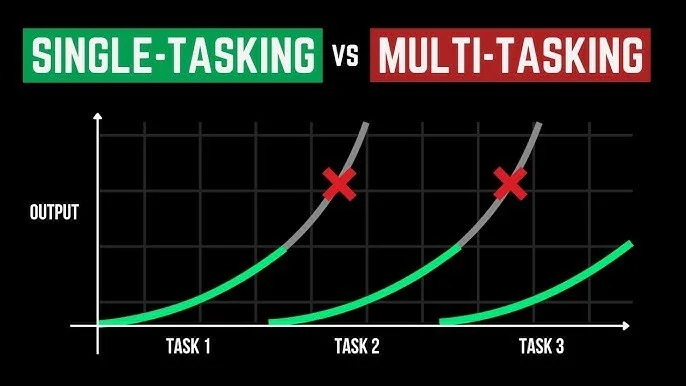
I have seen data that multi-tasking is a myth, yet I sure give it a go more often than not. I always say that when teaching, I have to be able to have 7 conversations at once and do 3 other things. I know that my quality of work improves when I only focus on one thing, but it is surely a tough habit.

18. Walk Slower
I was able to do this at one point in my life, so much so that people complained about it. Now, I seem to motor on just like everyone else. When I am going from one class to another, I am pretty much zooming. I need to mosey more often. This is a time and place thing, though. If I walk slowly in the hallway, I will be run over by 23904523 sophomores.

19. Take a regular day each month for silence and solitude
This would be great! I already have it planned out. I get up early and drive to a state park, such as Turkey Run. Go for a nice long walk. Stop somewhere to sit and listen.

20. Take up a hobby just for the fun of it"
I am a teacher, which means I am not rich and will never be. With that being said, however, I am gainfully employed, so we do not have to worry about food. So my fishing hobby is ultimately for no reason at all, and I am totally in love with it.
Look, I do not know how this is going to all turn out. There are a lot of things on this list that I think seem really obvious and easy to do. Others seem really difficult at this point in my life. Comer makes it clear that you do not have to do all of these things - just do something. So that is what I am going to do. Stay tuned.


Being ruthless sounds good, but its hard.
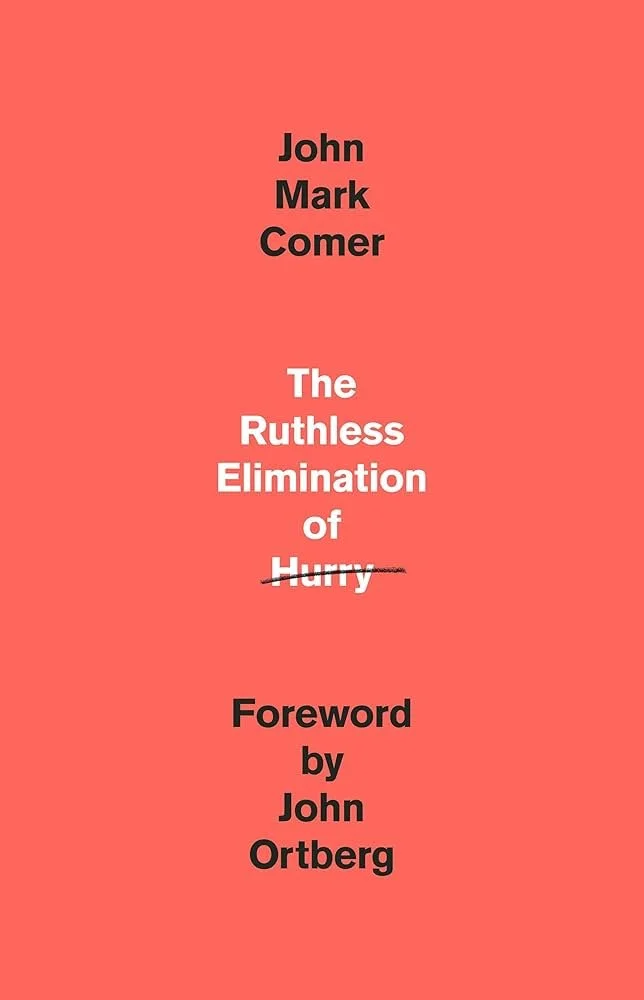
The Ruthless Elimination of Hurry is a nonfiction book that explores the benefits of slowing down your life to become more emotionally healthy, spiritually grounded, and present with others.
The central idea is that constant busyness isn’t just a scheduling problem — it’s a spiritual and psychological problem. Hurry quietly erodes joy, relationships, attention, and depth of thought. We don’t know how to live intentionally.
The book is about practical lifestyle advice and thoughtful reflections on faith, philosophy, and contemporary culture. It speaks of adopting habits such as rest, silence, simplicity, and intentional limits on technology, to create space for meaning rather than noise. These are things that a lot of us already know, but are so addicted to the world, we do not know how to shut it off.
In short, it speaks of a more thoughtful life in a world that rewards speed.
“Who is John Mark Comer?
John Mark Comer lives in Portland, Oregon and pastors Bridgetown Church, right in the center of the city. Bridgetown is built on the idea of practicing the way of Jesus together. John Mark has authored several books, including The Ruthless Elimination of Hurry and God Has a Name. John Mark said, “My life’s ambition is to be with Jesus, become like him, and do what he did. My prayer is that the stuff I make helps you do the same.””
The book starts with a personal turning point for the author. John Mark Comer was the lead pastor for several churches in Portland, Oregon, and goodness, were these churches growing. 1,000 new people a year for the better part of a decade. This sounds great, right? Thats a lot of new people learning about the good news of Jesus; that’s something that we are all about. The downside was that he found himself in a state of permanent exhaustion. Great anxiety and emotional fragmentation, despite outward success, led him to feel productive but hollow, crowded yet disconnected. As this madness came to a head, he sought help from a friend, John Ortberg, who had been mentored by Dallas Willard, who understood what he was going through. It came down to one word: hurry.
Hurry, in his case, was not a temporary malady; it had become his way of doing life. Not a minor inconvenience, but a destructive force that, if not destroying, was certainly undermining the truly important things: love, joy, peace, and spiritual depth.
How did this happen? Death by 1,000 cuts. Or maybe 2,617 - the number of times the average person touches their phone - taps, swipes, clicks - every day. (The higher end users are over 5,400). The really creepy part is that most of the leadership from social media companies sends their kids to schools where social media is not allowed - they know it is addictive and addictive by design. I knew a lot of these numbers, but I was appalled when I began to think about the opportunity cost of these amounts of time. Comer did not stop there. He talked about emails before going to bed, binge-watching TV shows (Landman, anyone?), and days upon days filled with meeting after meeting, which are superficial in nature and of little or no value. He was not fully there with his family. He was always in the middle of several text message discussions. He detailed an incredible frenetic life in a terribly frenetic way. His writing style was making me feel anxious. It was just so much, and I couldn’t imagine the amount of pressure he must have been under.
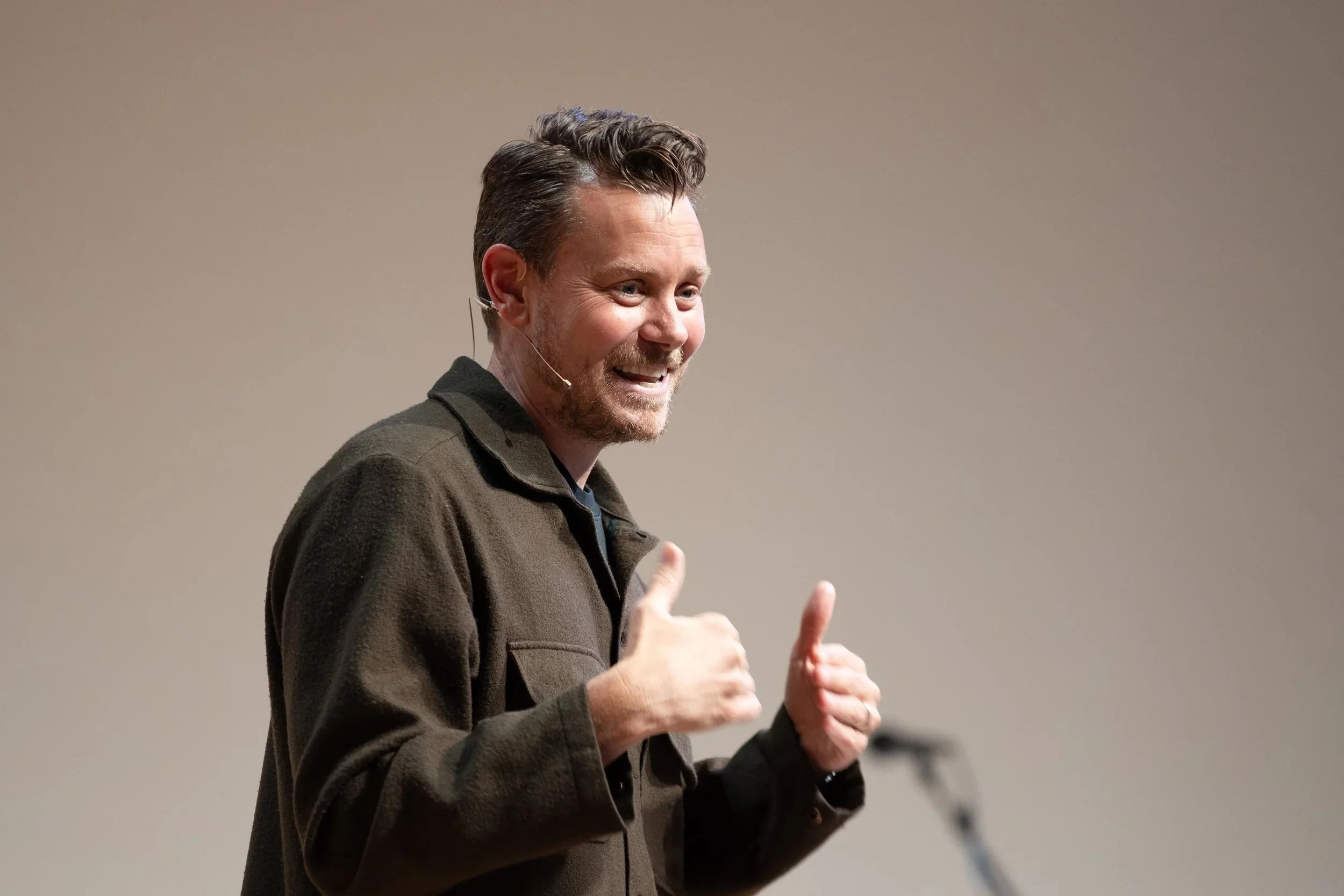
And then he stepped away. Decided to stop running several churches so that he could focus on just one. Stop being a mile wide and an inch deep and start paying attention to the things that really matter, deeply and intentionally.
He took flak for it. Some said he was not following God’s plan for his life. That he was selfish. I think that was an absurd notion, especially in light of the focus of why he slowed down: He wanted to be more like Jesus. Can you think of one single time that Jesus was in a hurry? I cannot. In fact, I can think of lots of times when Jesus might have hurried and did not. Oh, Lazarus is going to die? Jesus did not leave for 2 days. He. Did. Not. Hurry.
Essentially, the prologue sets up the book’s central thesis: A hurried life is incompatible with a deeply formed inner life, and eliminating hurry is vital to becoming a healthier, more present human being.
My personal takeaway was that I could really do a lot more to close the distance with Christ. I waste an amazing amount of time. What has the opportunity cost been of this lifestyle? I tried not to think too long on this one, as there is not a damn thing I can do about what has been. There are some changes that I need to make.
Part One: The Problem: Hurry: The Great Enemy of Spiritual Life
“If the devil can’t make you sin, he’ll make you busy,” Corrie ten Boom
When you meet someone and ask how they’re doing, what is the standard response? “Good, but really busy.”
There is good busy. When I am doing meaningful things: spending time with family, etc.
Jesus was busy
This new speed of life is anti-Christian
Our speed goes against loving the Lord with all your heart, mind, and strength.
When we are totally spent, running late, and overloaded, pay attention to the way in which we treat the people we care about the most.
Hurry and Love are oil and water - they just do not mix
We speak of walking with God; no one talks about running with God. It is because God is love; no hurry.
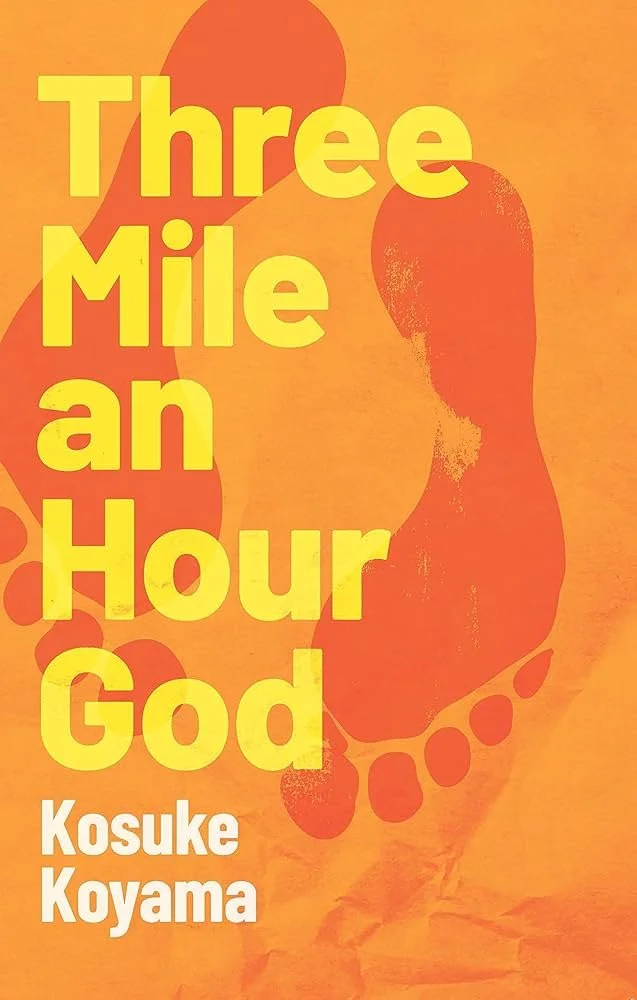
“God walks slowly bc He is love. If He were not love, He would have gone much faster. Love has its speed. It is an inner speed. It is a spiritual speed. It is a different kind of speed from the technological speed that we know. It is slow, yet it is lord over all other speeds since it is the speed of love.” Kosuke Koyama - Three Mile and Hour God
In our culture, slow is a pejorative.
In our culture, the message is clear: fast is good, slow is bad.
Secret to happiness/mindfulness - presence to the moment. The more present to now, the more joy we tap into.
When late or hurrying, feel any shalom??
When my kids are dragging to get out the door, am I the best version of myself in that moment?
“I cannot live in the kingdom of God with a hurried soul” - John Ortberg
I am more distracted than non-spiritual. When I become more interested in what TV show, YouTuber, post, sport, or whatever, and the fantasy life they create in my mind, than I am in church.
Pathological busyness.
There are times for hurry - water broke?? Hurry!
Is busy contagious? If everyone is doing it, does it impact you such that you speed up?
If I am so distracted, will I skim my life instead of actually fully living it? Could my spiritual life be at risk based on how I spend my time?
41 “Martha, Martha,” the Lord answered, “you are worried and upset about many things, 42 but few things are needed—or indeed only one.[a] Mary has chosen what is better, and it will not be taken away from her.” Luke 10:41-42
This is all not a new thing - this idea of distractedness and how we spend our hours. When the sundial was invented, people in Greece freaked out that it was going to destroy their way of life.
Clocks which were built to tell people when it was time to pray. Prior to this, the sun and moon gave us the rhythm of the day.
Artificial time is not so good. Perhaps we became more efficient when we started using clocks, but the circadian rhythm took a big hit. Plus, God controls the sun and moon. Now, clocks/employers tell us when to sleep.
Before the lightbulb, the average person used to sleep 11 hours a night. Today, we think that 7 hours is enough. No wonder we are all so damn tired.
The concept of wealth has changed. Before you were wealthy, if you had a lot of leisure time. Now, if you are working 80-hour weeks, you are judged wealthy. Busy is judged as success!!
It should shock no one that keeping the Sabbath holy has gone by the way side. There used to be places that would close on Sundays. No more. We not only lost a day of rest, but we also lost a day for our souls to be with God.
2007 - the iPhone drops, and our distractedness explodes.
The real question is what all of this distraction, etc. doing to our souls
Hurry Sickness
Irritability - way too easy. Tiny things piss you off. To diagnose, look at how you treat the people closest to you.
Hyper sensitivity - minor comments to hurt your feelings, grumpy emails. Small things quickly escalate into major events. Ordinary problems have disproportionate impacts on your emotional well-being.
Restlessness - when you do try to slow down, you can’t. Can’t focus on reading. Quiet time with God, and you cannot quiet your mind. Go to bed and toss and turn. When you're hyped up on speed, and you do not get the next dopamine rush, you can’t deal.
Workaholism or non-stop activity - you cannot stop or do not know how to stop. Can be careerism or obsessive house cleaning. By day’s end, you have nothing left to give to the people closest to you.
Emotional numbness - you can’t feel your own pain or that of others; empathy is not something you have. There is no time for this.
Out of Order priorities - disconnected from your identity or calling. Life is reactive, not proactive. You feel like you do not have the time for the things that really matter to you. You get sucked into the world of urgent, not important.
Lack of care for your body - sleeping well, exercising, gaining weight, waking up tired. Live off caffeine, sugar, processed carbs, and alcohol.
Escapist behaviors - when we are too tired to do what is actually good for our souls, we turn to the distraction of our choice. Eating, drinking, binge-watching Netflix, surfing the web, and social media. They are okay in small doses, but when they become the norm or are abused to escape reality, they eat us alive. We get stuck in the negative feedback loop of socially acceptable addictions.
Slippage of spiritual disciplines - when we get too busy, the things that are truly life-giving for our souls are oftentimes the first thing to go; we let them go, instead of leaning into them during the tough times. Quiet time in the morning, reading scripture, prayer, sabbath, worship, meals with family. The things that make for rest actually take some emotional energy and self-discipline. When over-busy, we get over-tired, and we no longer have the energy or discipline to do what we need most for our souls. We don’t have a life with God, we have a life with TV and a glass of wine. We do not feel soul-rested after watching Netflix like we would if we spent some time with God. Emotional crash incoming…
Isolation - you feel disconnected from God, others, and your own soul. Rare times when we stop to pray, and I mean sit with God in the quiet. We are so stressed that we cannot enjoy the father’s company. Same with friends. We cannot set the phone down or a million miles away in your mind.
Now, score it - how many of these actions describe what you do? Do not feel guilt or shame for how many you get.
We are doing violence to our souls. We do not have time for love; love takes time. Relationships take time. We don’t have the time for the people we love.
It kills wisdom. Wisdom is born in the quiet, the slow. It has its own pace; it will make you wait for it. The inner voice will wait till the waters are calm and you are ready. Other times, the voice can be heard, but we are too busy to listen to it.
Attention is the start of devotion. No energy, no attention. Attention is our scarcest resource.
The two things that we used to think of as the most valuable are time and money. But attention is more vital; it leads to awareness. In the problem of humans not feeling connected to or near God, it is not God’s fault. God is everywhere and every time. It is our awareness of God that is the problem.
We are the ones who are absent, not God.
Where you put your attention, it is what you will become.
We become what we give our attention to.
“For what does it benefit someone to gain the whole world and yet lose his life?”
Citations:
Sussex Publishers. (n.d.). The hurry sickness of Hustle Culture. Psychology Today. https://www.psychologytoday.com/us/blog/optimized/202601/the-hurry-sickness-of-hustle-culture
Hailes2017-11-23T00:00:00+00:00, Sam. “John Mark Comer: Reaching America’s Most Secular City.” Premier Christianity, 23 Nov. 2017, www.premierchristianity.com/interviews/john-mark-comer-reaching-americas-most-secular-city/874.article.

Small Group 2-12-26
When are we going to meet next? 2/23/26
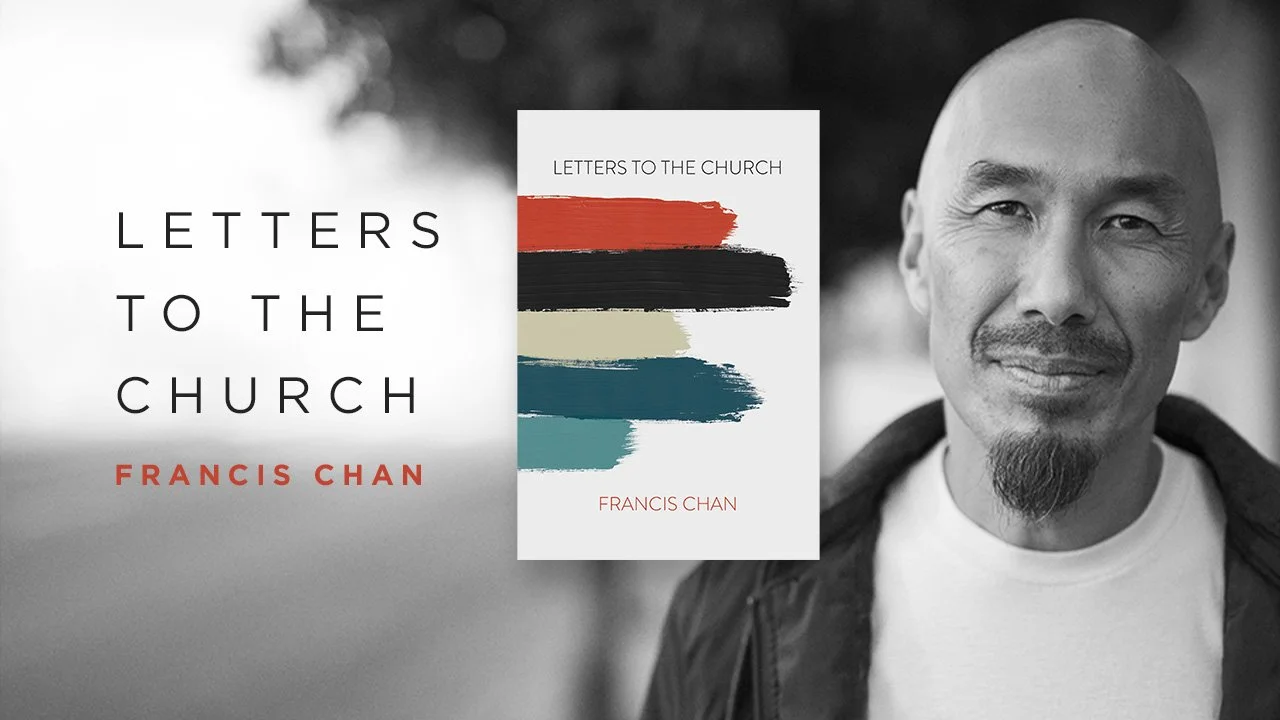
What are we going to study/talk about? Ruthless Elimination of Hurry or Letters to the Church

Film as Literature - Tri 3 Movie List
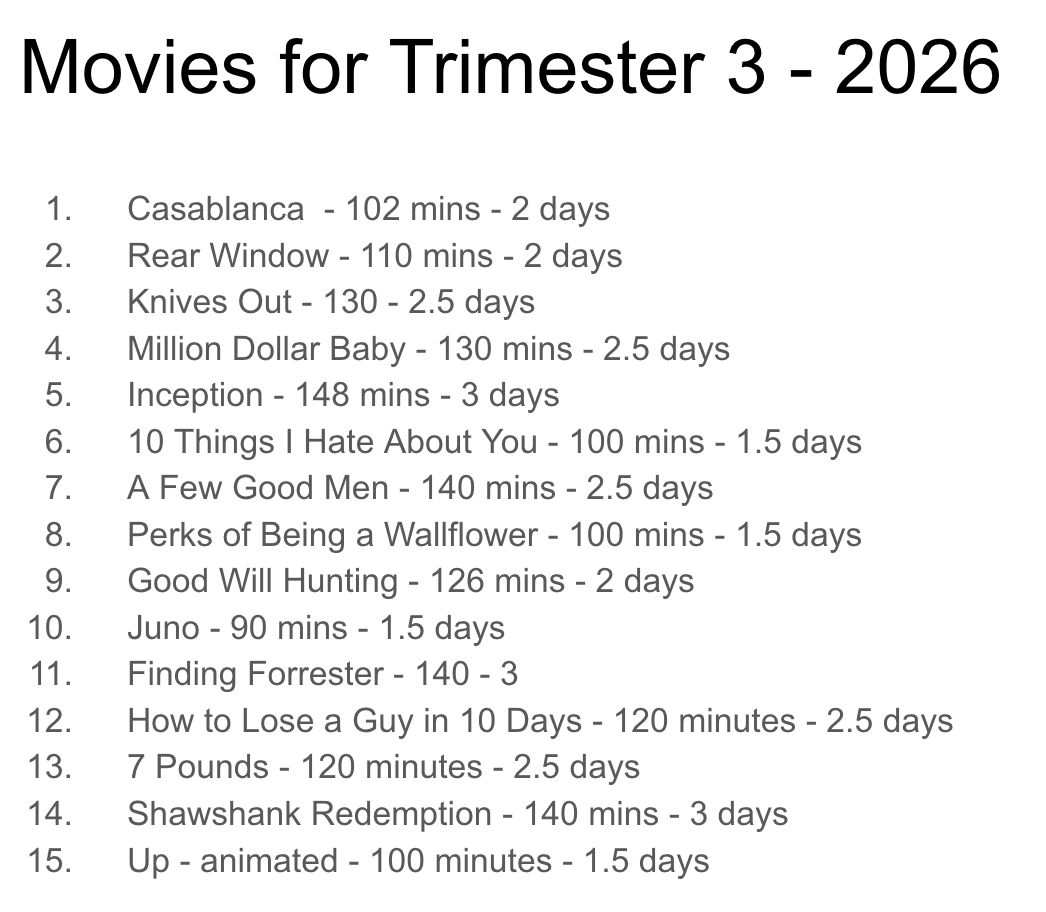
Well, here it is - The List for my third-trimester Film as Literature class. Since I know I will need to validate my choices repeatedly, I will do so here. Per normal, I will leave the box at the bottom open for you to send me your vitriol.
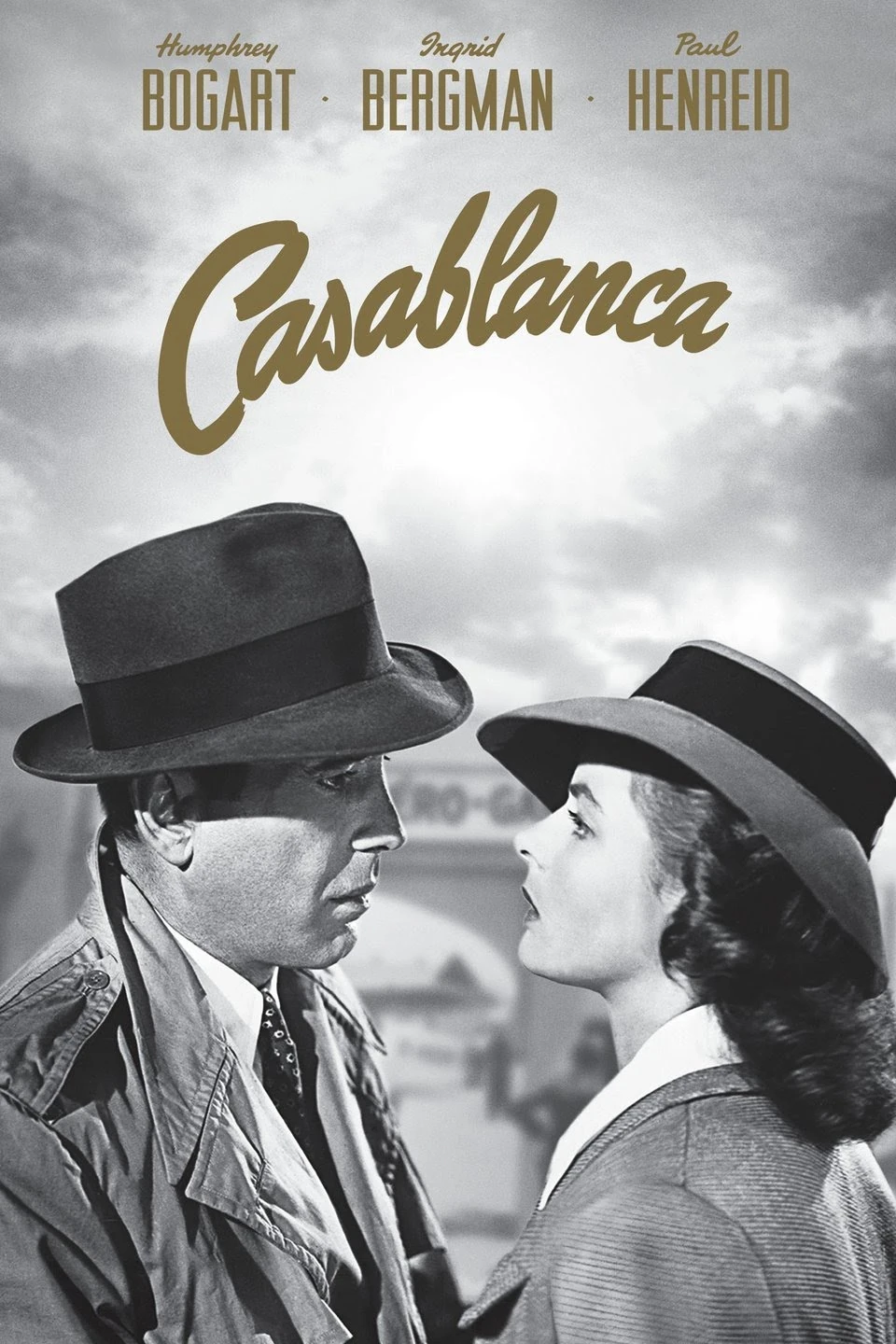
Casablanca 1947
The Humphrey Bogart and Ingrid Bergman classic. In black and white. Historical and propaganda-laden romance film that is almost universally disliked by students - I hear about it often. Alas, it is a classic film with some of the most recognizable quotes of all time. Sorry kiddos.
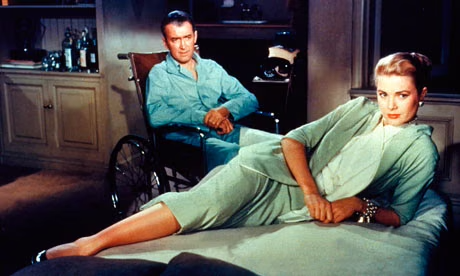
Rear Window 1954
This is a truly underappreciated film featuring Jimmy Stewart and the Princess of Monaco, Grace Kelly. She makes quite an entrance, and the gender discussions underscore a good thriller. Jimmy Stewart is basically in a chair the whole time and experiences some truly terrible special effects at the movie’s climax.
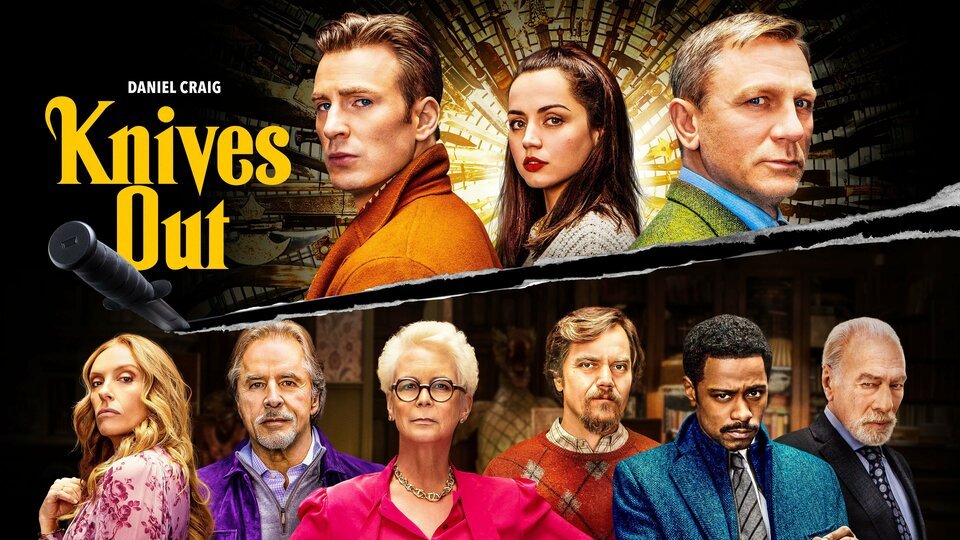
Knives Out 2019
Classic whodunnit with a great ensemble cast. This was the first movie I saw with Anna DeArmas in, and she plays her role very well. Keeps you on the edge of your seat until the end.
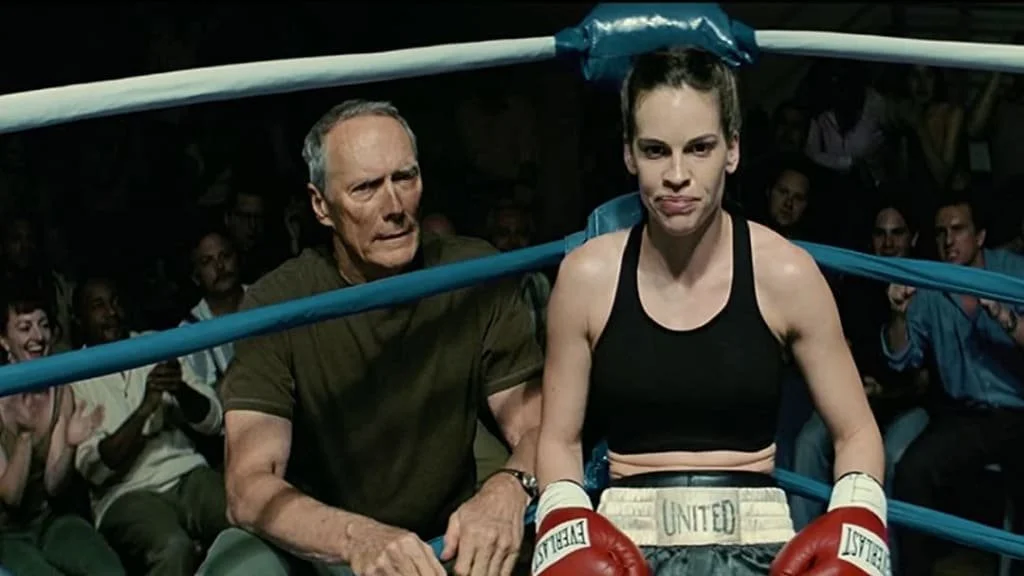
Million Dollar Baby 2004
Tears, they are inevitable. Unless you have no soul.
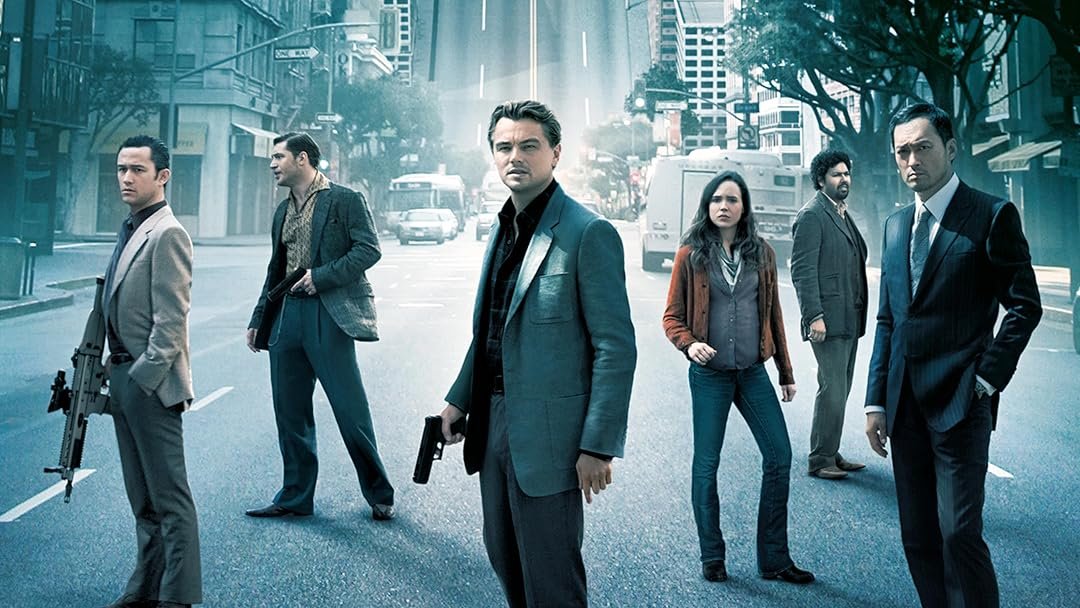
Inception 2010
Easily the hardest movie to follow we watch all trimester. Great special effects and character arc from Leonardo DiCaprio.

10 Things I Hate About You 1999
First trimester, I was told in no uncertain terms by some of the girls in my class that my list of movies was filled with “dude movies.” Upon reflection, I realized they were right. This movie came to mind really quickly. A coming-of-age film that is based on Shakespeare’s Taming of the Shrew, it is filled with teenage angst and invective, enough so that the comment about “dude movies” died out pretty quickly.

A Few Good Men 1992
There are a good many courtroom dramas that are really good. The Rainmaker 1997 or Runaway Jury 2003 and lots more, but this one is one of my favorites. Great actors, good arcs, good film. Rob Reiner, RIP.
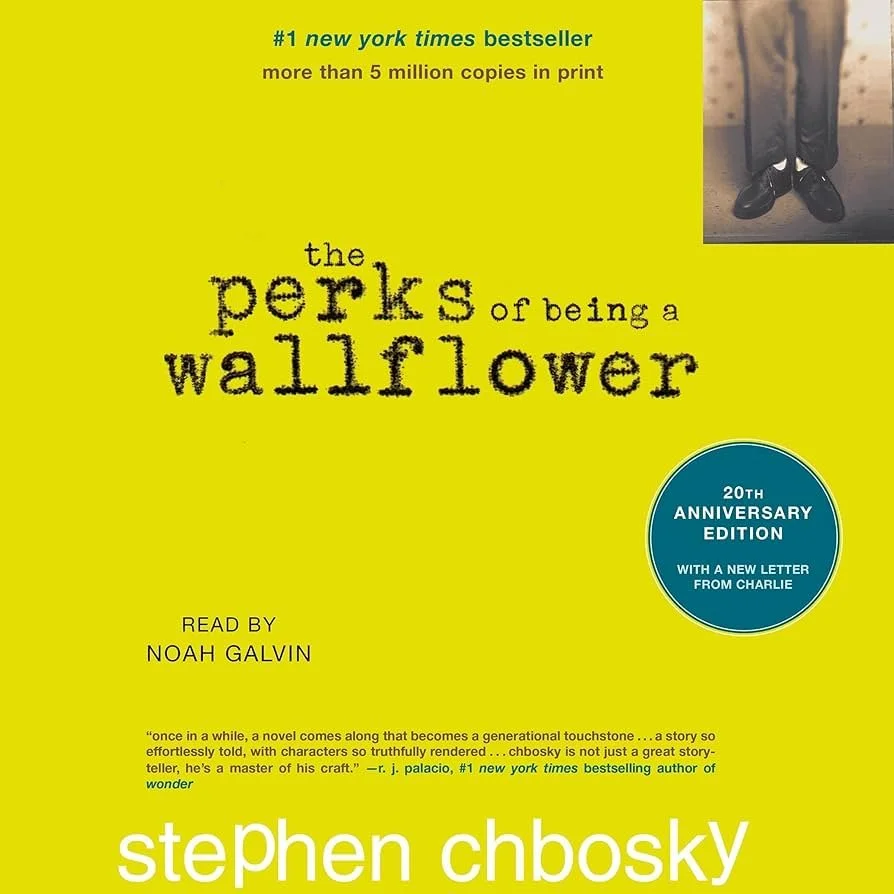
Perks of Being a Wallflower 2012
Another coming-of-age, but far more serious than 10 Things. This one deals with serious issues that are part of the becoming an adult - issues that are more and more prevalent in today’s high schools.
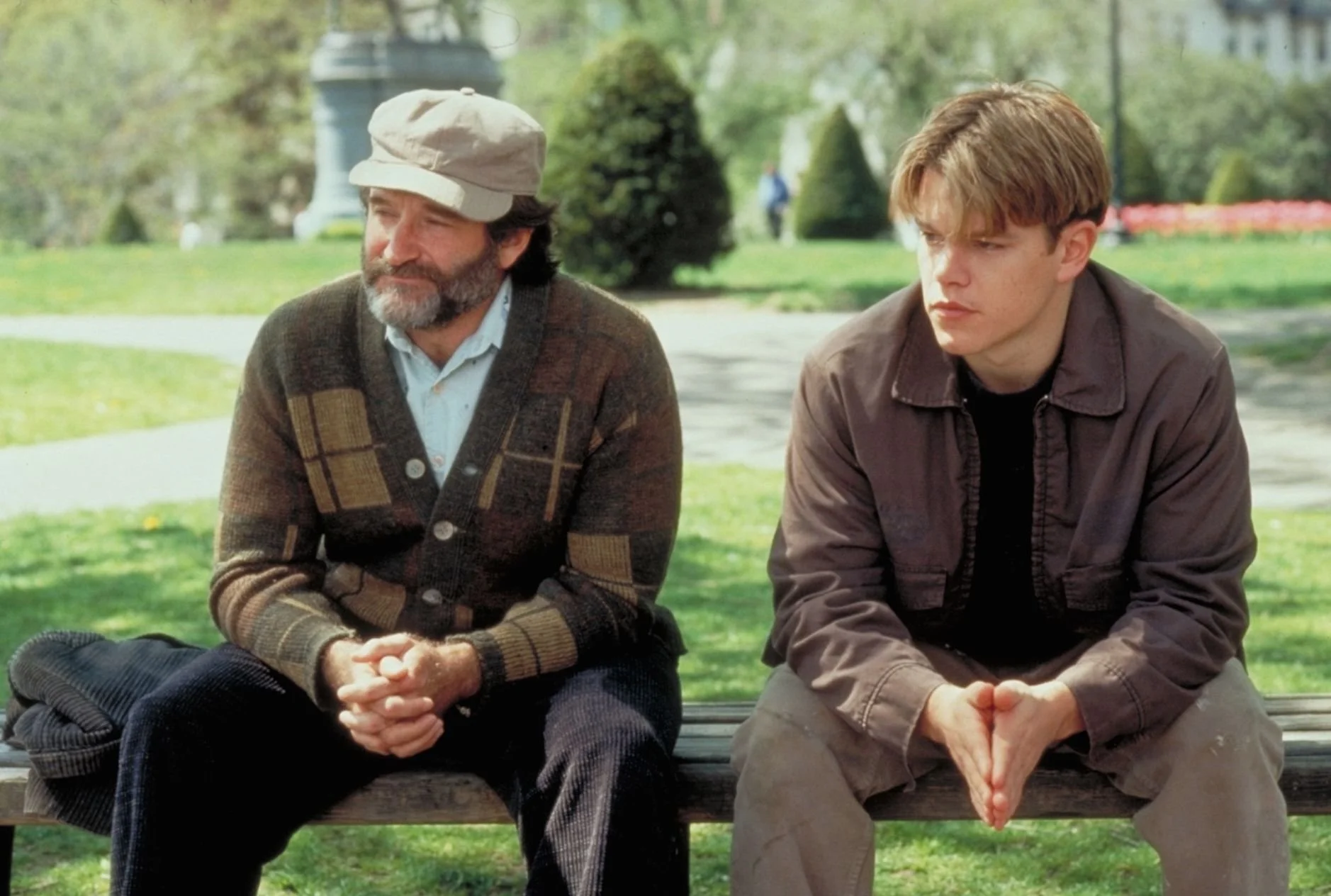
Good Will Hunting 1997
This had to be in the list. There is such a cool amount of lore regarding this film - for instance, they almost lost the rights to it until Miramax (yes, Harvey Weinstein) came in and let them do it, but only after Robin Williams signed on.
It is unquestionable crass and coarse, but you could write books on the character arc of Will Hunting alone. Standout film.
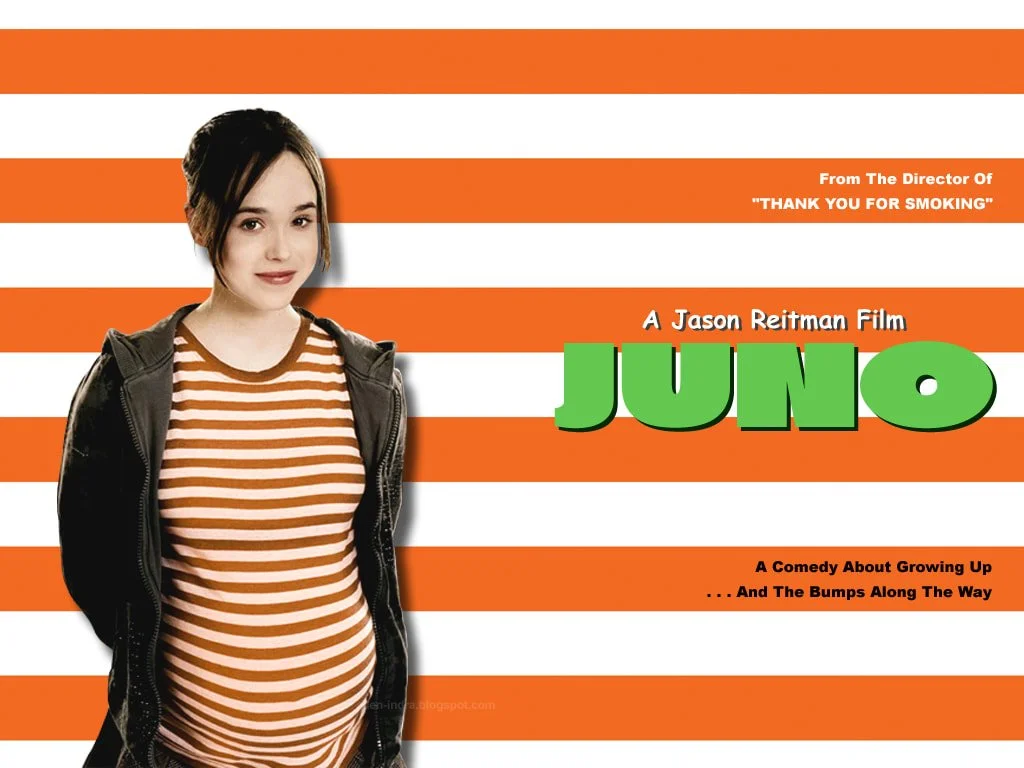
Juno 2007
Underneath all of the fast dialogue and good music, its a pretty thoughtful story and responsibility, identity, and growing up faster than you might have wanted to. Jason Bateman also plays a total ass (not the likable one he plays in so many other movies) really well in this movie.
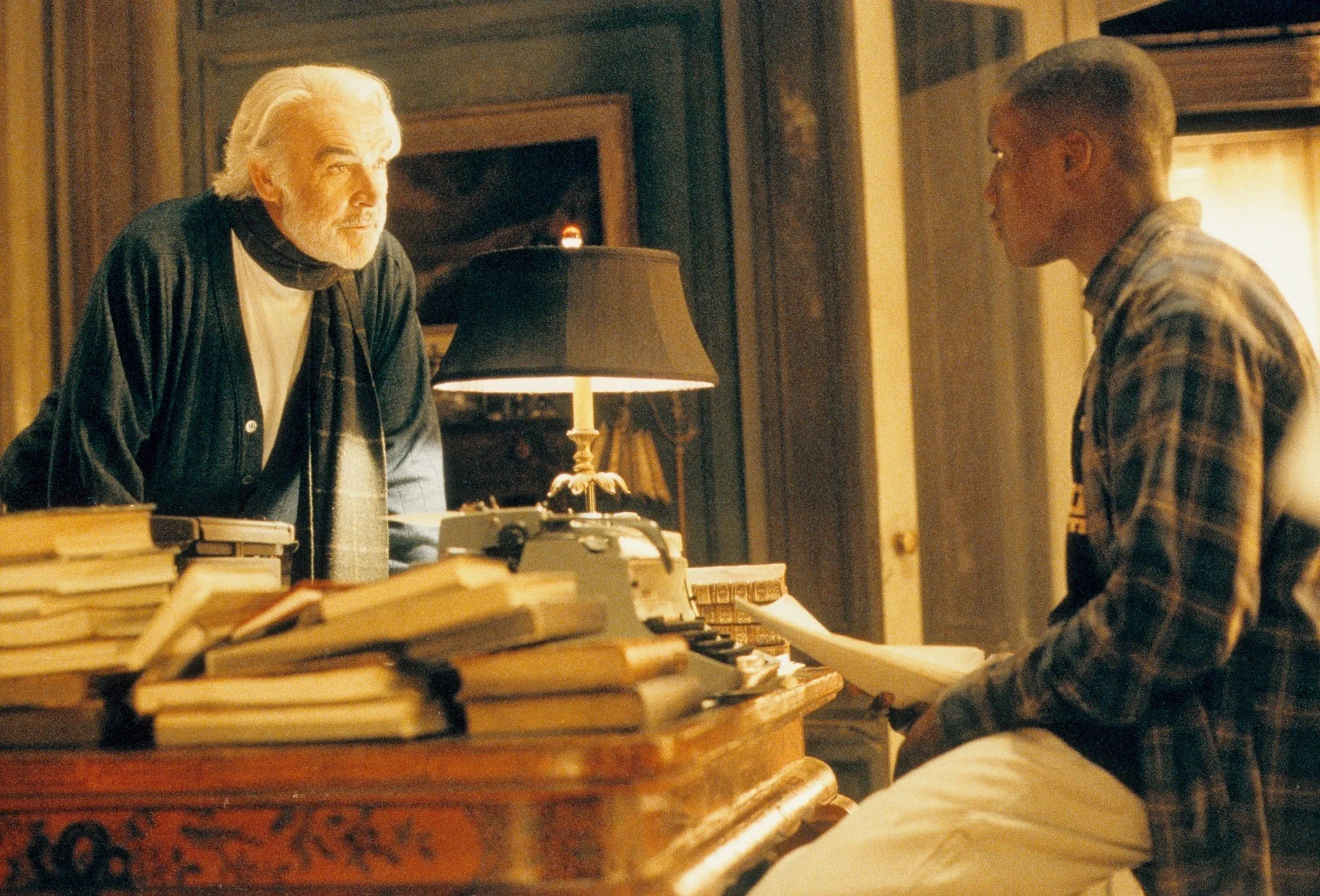
Finding Forrester 2000
This is just such a great film, a movie about writing disguised as a basketball movie. Rob Brown, who plays the protagonist Jamal Wallace, auditioned trying to get a position as an extra to pay off his cell phone bill. Gus Van Sant of Good Will Hunting fame saw something in him and gave him the role. It has a great score as well, very fitting for the imagery.

How to Lose a Guy in 10 Days 2003
More reaction to my “dude movies.” This title came up and I had access to it, so I went with it. Its…okay.
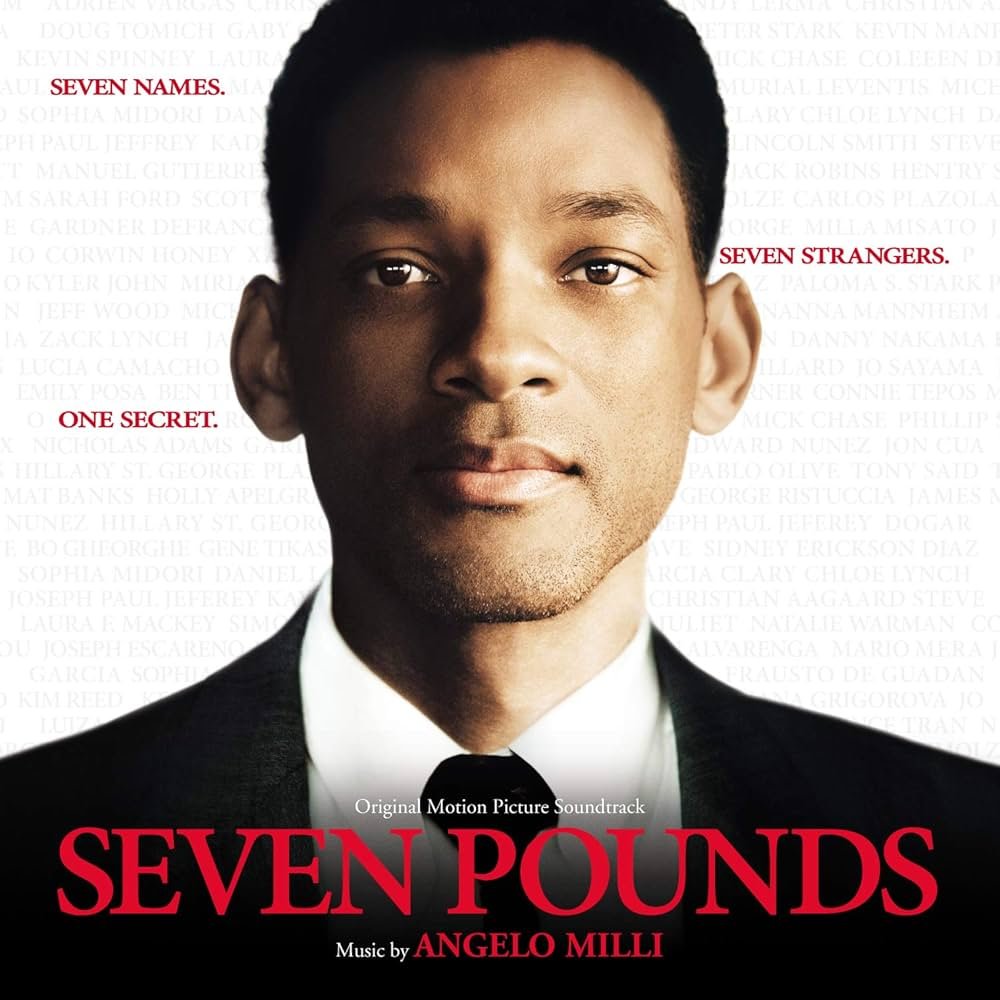
7 Pounds 2008
Before he was assaulting people at awards shows, Will Smith made some pretty good movies. This is one of them. The end is really amazing and I did not see it coming at all. This one brings tears.
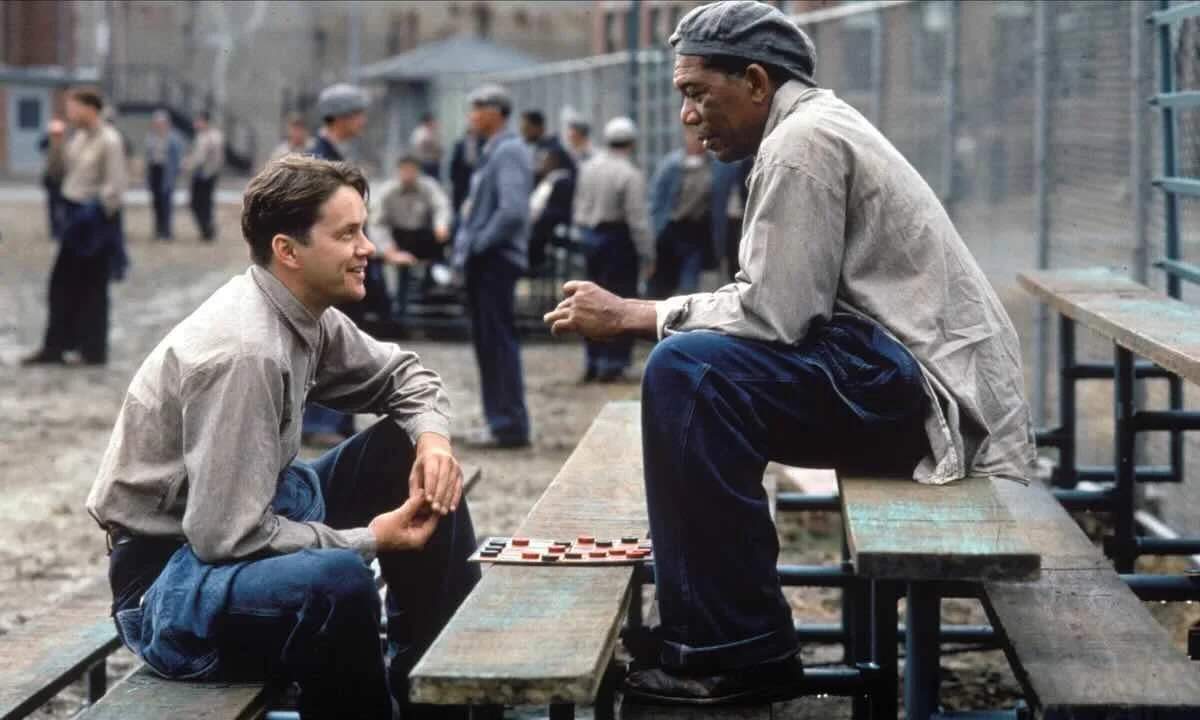
Shawshank Redemption 1994
If you do not know of or like this movie, I just do not know what to say to you, you uncultured swine. “Get busy living, or get busy dying”
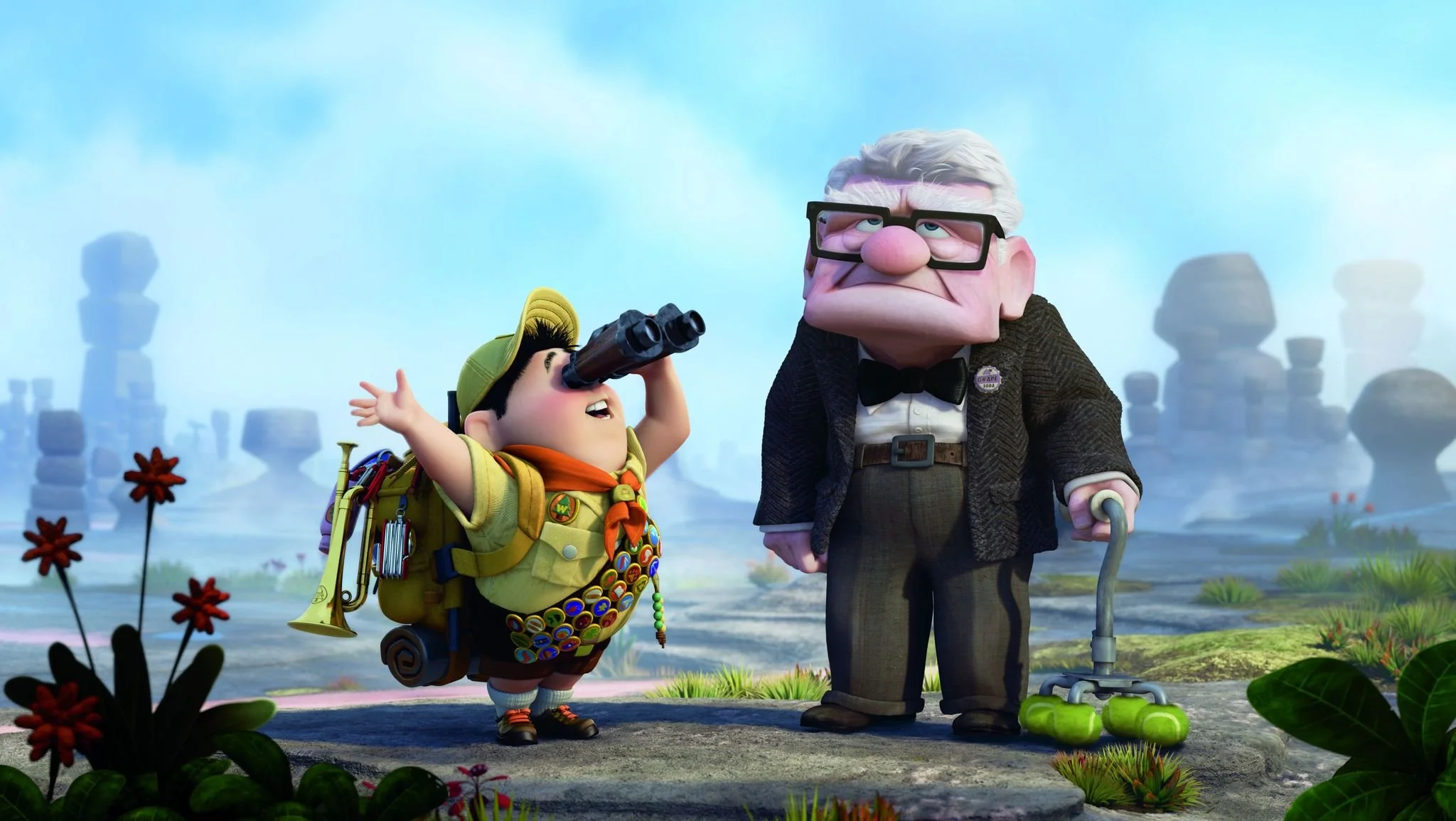
Up 2009
Perhaps this movie resonates with me as I continue my march towards looking like Carl Fredericksen, the old man on the right. Or it is because I was lambasted for not having a single animated movie on the list.
I have not been teaching Film as Literature very long, so initially I was not going to change the lineup too much. Well, enough of that. There are several movies on this list that I have never used before so I will be interested to see what kind of reaction they get. Good reviews or bad reviews, I am sure I won’t have to wait long to hear what my students think.

The Road by Cormac McCarthy
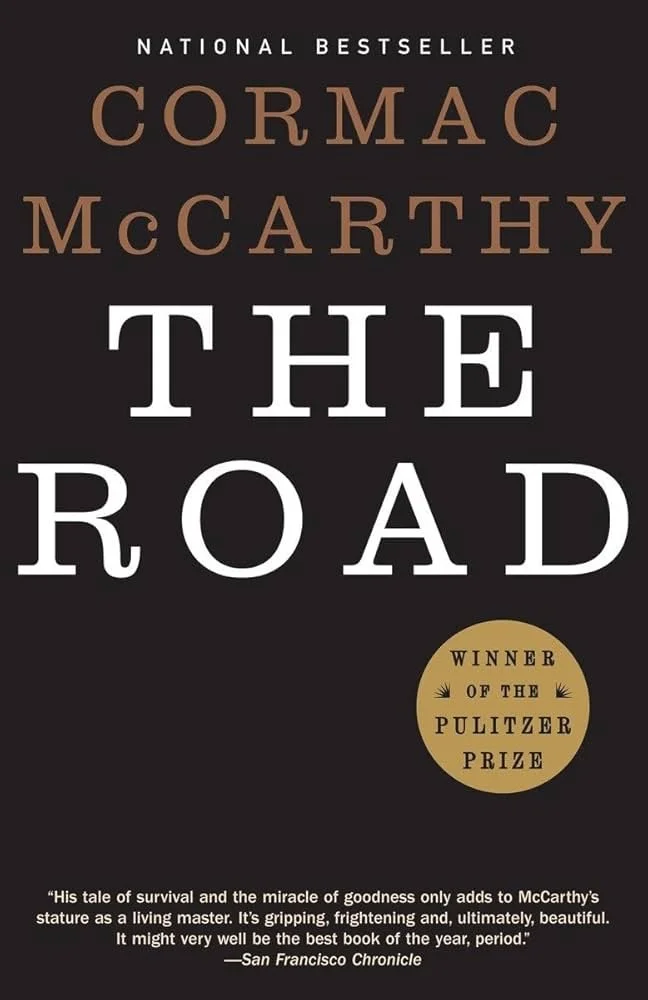
I am always on the lookout for another book to read. Saw The Road by Cormac McCarthy in the library at school, which, by the way, does a really good job of putting books out for students (and teachers) to see. I noticed that it was a Pulitzer Prize winner, so I thought it would be a good read. I asked Sarah Gibbs, WHS's everything person, about it and became more intrigued. Libby app here I come.
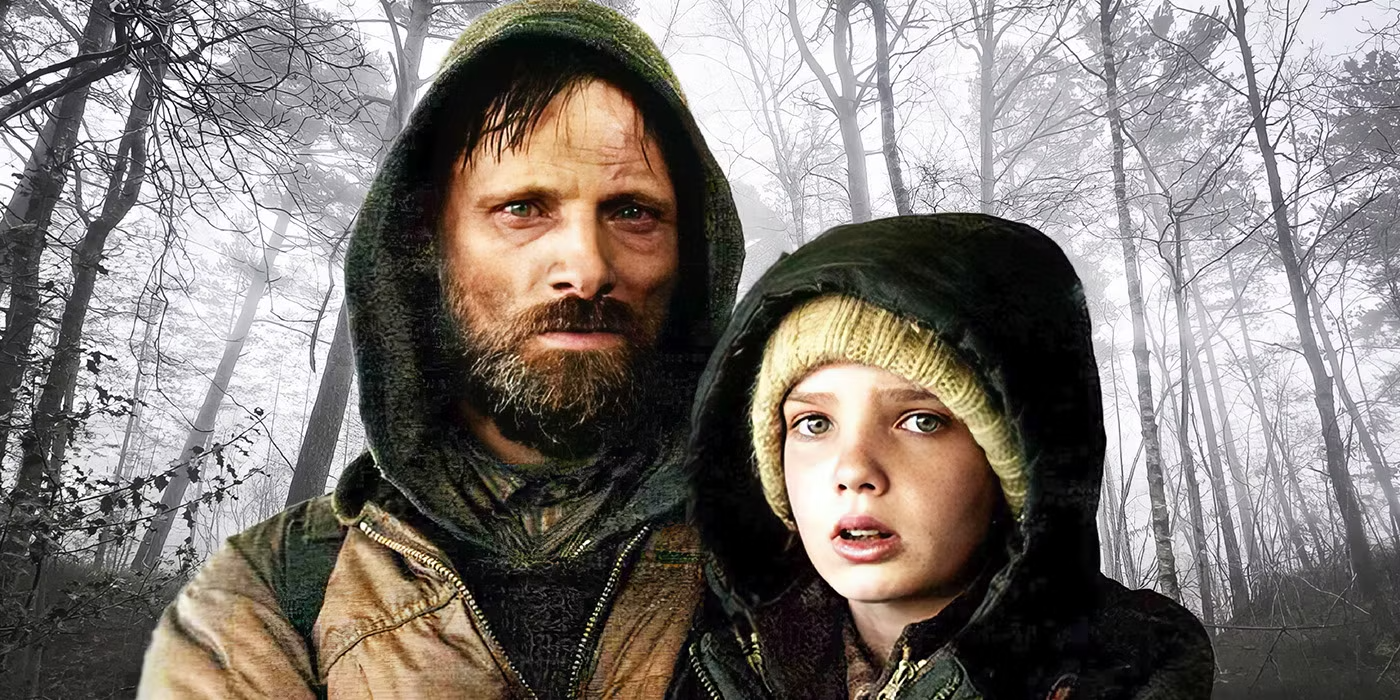
Goodness gracious, this is a depressing read. It is ponderous and macabre and morbid, yet all the while hauntingly fascinating. The Road is a stark novel that takes storytelling down to the bare essentials. Set in a post-apocalyptic world where civilization has totally collapsed, the book follows a father and son as they journey south through an utterly destroyed America, where the only hope is to try to survive another day. There is no explanation as to why the world ended, but there are clues along the way. I believe that this was an intentional choice. The story is less about what happened and more about what remains when all things familiar have disappeared. This yarn is about enduring hardship, love, and attempting to maintain one’s moral compass. In this world there are no rewards for goodness of character.
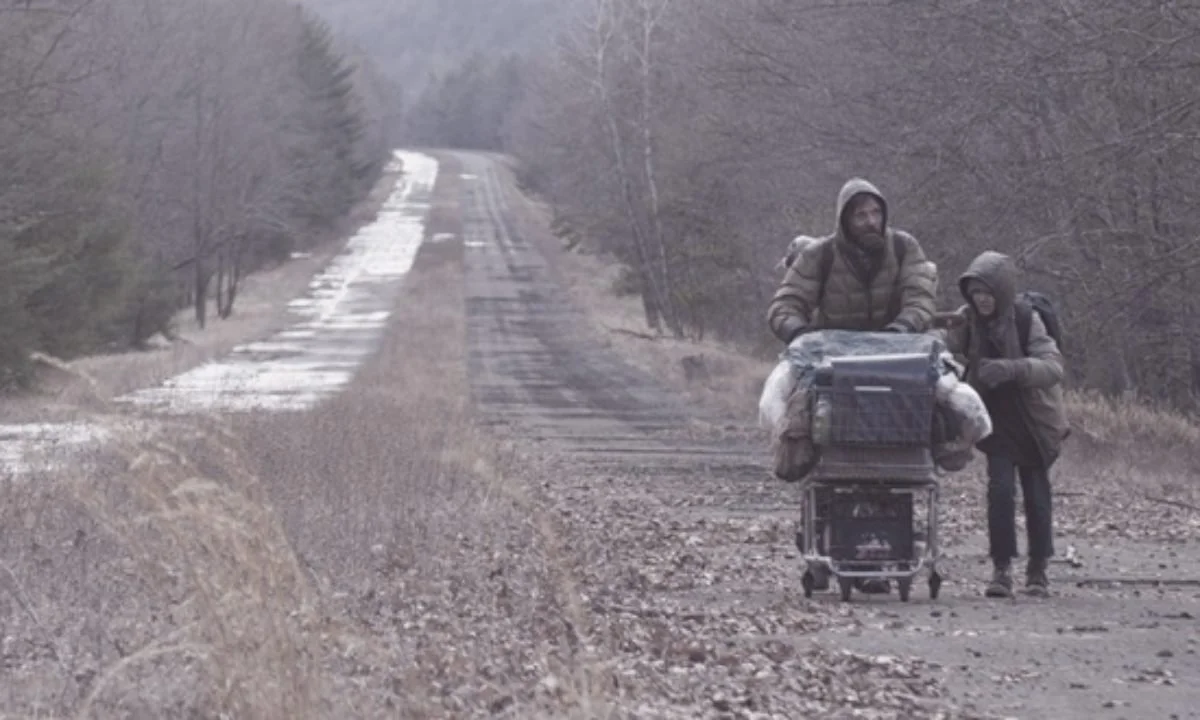
This picture pretty much depicts the gray nature of McCarthy’s writing - drab and dismal.
For me, the writing style was painful. McCarthy’s prose is Spartan and fragmented, which adds to the overall unsettling nature of the book. There are no chapter breaks; it feels like one long stream of consciousness. But what was the most difficult to parse was the lack of quotation marks in the dialogue. It was challenging at first, forcing me to slow way down and sit with each moment, making those moments even more poignant. This method also seemed to become more and more effective as the novel progresses. McCarthy manipulates emotion with the amount of dialogue that he uses as well. The silence between dialogue sets echoes the emptiness of the landscape and emphasizes how little comfort language itself can provide in such a bleak setting.
At the heart of the story is the relationship between the father and the son, which provides the book’s emotional core. Fiercely protective, the father will stop at nothing to keep his son safe. The boy is all about compassion, innocence, and morality. The phrase, “carrying the fire,” came to represent the preservation of humanity and ethics - the values that were prized before the apocalypse. This resonates with me. As a father, one of my primary responsibilities is to protect my family, and this book had me pondering how far I would be willing to go to ensure their safety. Would I be willing to forego my humanity to protect my sons? If survival necessitated cruelty, I think I would be on the side of the father. I assuage the guilt this causes me by telling myself I am just being as pragmatic as the father in the story. His pragmatism and the boy’s empathy created difficult questions about what being “good” meant in their broken world.
The dichotomy that hinges on “carrying the fire,” while clearly the main point of the story, was not enough to keep me from wondering over and over about what destroyed the planet. There were pretty significant hints along the way. McCarthy wrote about the ever-present ash that covered everything, and it got me thinking about what would cause that. I considered nuclear war, whose holocaust would cause a nuclear winter that would fit with many of the planet’s symptoms, but radiation was an issue that was never spoken of. Meteor striking Earth? Maybe a super volcano exploding? Both of these would leave ash covering the land for thousands of miles. This ash would destroy plant life as well as block the sun, which would account for the cold temperatures that father and son were constantly battling and the lack of plant life. I went online and discovered that I was not the only one who was asking these questions, but unfortunately, no one had any answers that were better than mine.
McCarthy doesn’t fear exploring the baser side of humanity by examining what people will do when they are afraid, isolated, and with the world in total moral collapse. When push comes to shove, people are capable of truly horrifying acts. If you and your family are about to die of hunger, cannibalism becomes acceptable. One of the worst scenes is when father and son find a basement filled with people who are kept in chains, missing various body parts that have been cut off, cooked, and eaten. With all that being said, the story is never allowed to be totally hopeless. Along the way, small acts of kindness, trust, and the loving bond between father and son demonstrate that goodness can exist even while society has devolved. This up and down between goodness and hope is what kept me engaged, willing to process the depths of depravity and keep reading.
On the Road is no walk in the park, but it does leave a mark. It forced me to question what I would do were I in that situation - where would I stand regarding my morals and ethics if the concept of just getting through the day was where my focus lay? It left me thinking that no matter what happens in life, some things are worth “carrying the fire.” Love of family and the ideals of right versus wrong are to be protected no matter the cost.
It was with mixed emotions that I finished the book - McCarthy adroitly weaves a tale that is a marathon of distress and anguish that I was happy to finish in some ways, yet a beacon of perseverance and hope in others. It is still something I think about.